
TL;DR
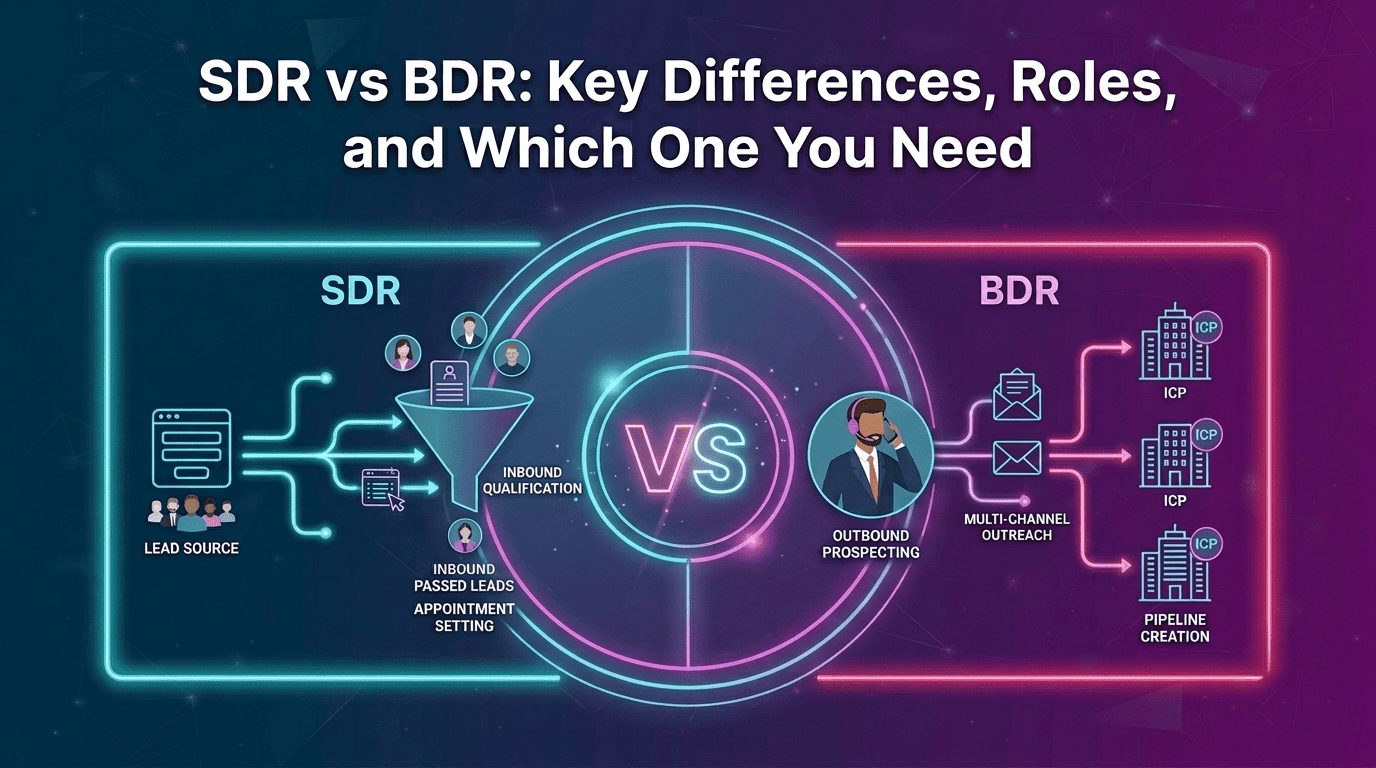
An SDR qualifies inbound leads that are already interested, while a BDR creates a new pipeline through outbound prospecting. The right choice depends on where your funnel is leaking: unworked inbound calls for an SDR, while a thin pipeline for a BDR. But before hiring either, identify the website visitors already showing buying intent but leaving without filling out a form.
SDR or BDR? The wrong choice can leave your pipeline stuck before a deal even starts.
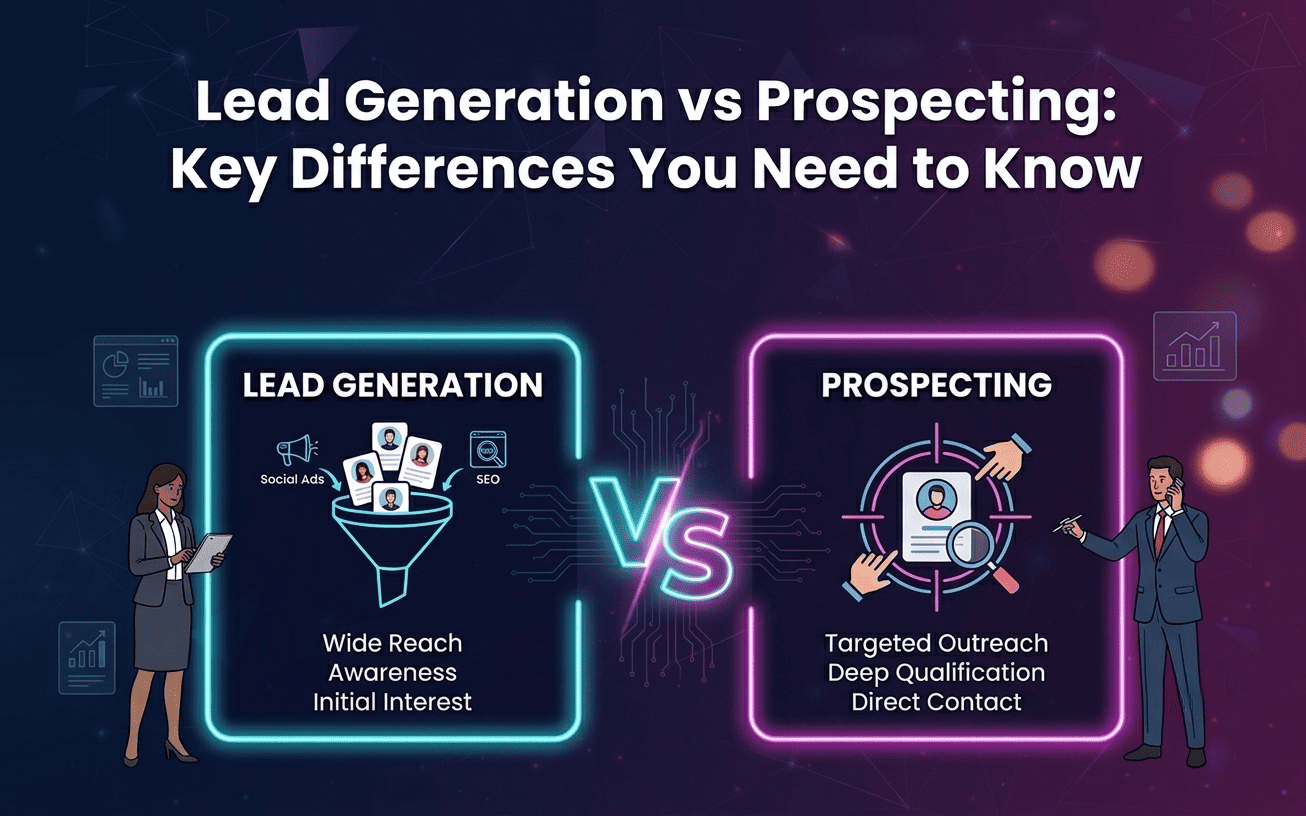
An SDR works the demand you already have. A BDR creates demand where none exists. Simple in theory, but the line gets blurry fast when companies use both titles differently.
That confusion can lead to the wrong hire, the wrong KPIs, and months of weak pipeline.
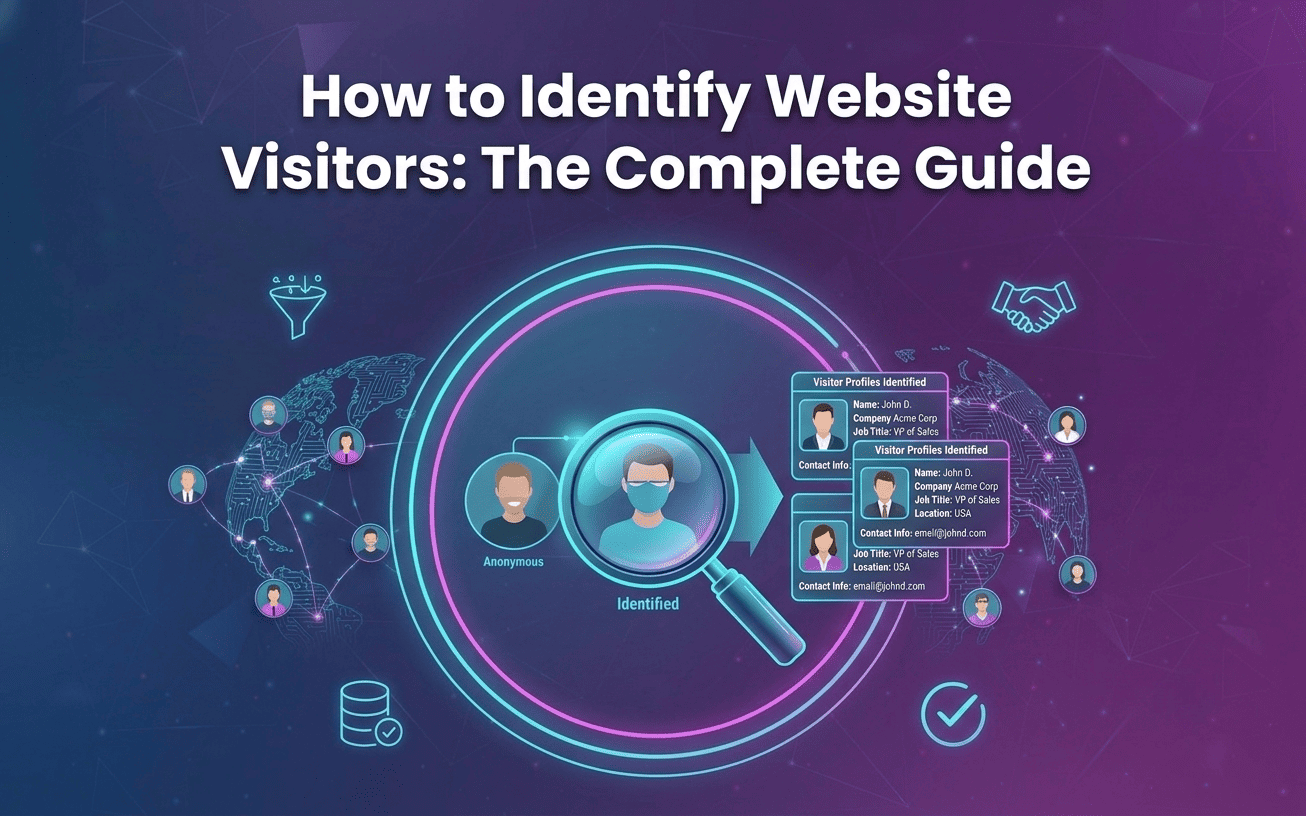
There is another problem most SDR vs BDR guides miss: your best prospects may already be among your anonymous website visitors.
They are reading your pricing page, comparing solutions, checking case studies, and leaving. Your SDR never sees them. Your BDR never gets them on a target list.
So the real question is not just, "What is the difference between an SDR and a BDR?"
It is which pipeline motion your business needs right now, and what you're missing before either role gets involved.
In this guide, you’ll learn:
- What SDRs and BDRs actually do
- The key differences between both roles
- Which KPIs matter for each motion
- Why companies define these roles differently
- When to hire an SDR, BDR, both, or neither
- Where human sales development breaks down
- How an AI Business Developer can capture demand your team currently misses
By the end, you’ll know which sales development motion fits your pipeline, where the real gaps are, and what to fix before adding another seat.
What Is an SDR (Sales Development Representative)?
A Sales Development Representative (SDR) works with leads that already show interest in a company. These leads may come from demo requests, content downloads, webinars, or website forms.
The SDR contacts them quickly, checks if they are a good fit, and books qualified meetings for an Account Executive (AE).
SDRs usually do not close deals. Their main job is to qualify interested leads and pass the right ones to the sales team.
Core SDR Responsibilities
- Respond to inbound leads: Contact new leads quickly while their interest is still fresh.
- Check lead fit: See if the lead matches your Ideal Customer Profile (ICP).
- Qualify prospects: Ask about their needs, budget, timeline, and role.
- Follow up with leads: Stay in touch with prospects who need more time.
- Book qualified meetings: Schedule sales calls for Account Executives (AEs).
- Share lead context: Give the AE key details before the meeting.
- Update the CRM: Keep lead status, notes, and activity accurate.
- Filter poor-fit leads: Remove leads that are unlikely to become customers.
Pros
- Warmer conversations: Every prospect already knows your company exists
- Faster feedback loop: Results show up within weeks, not quarters
- Sharp discovery skills: Constant qualification calls build strong questioning instincts
- Clear structure: Playbooks, routing rules, and scoring give reps a defined lane
Cons
- Dependent on marketing: Thin inbound leaves the seat with nothing to work
- Pressure on response time: Minutes of delay cost real conversion
- Repetitive volume: The same qualification questions, dozens of times daily
- Blame magnet: SDRs absorb criticism when marketing and sales disagree on quality
What Is a BDR (Business Development Representative)?
A Business Development Representative (BDR) creates new sales opportunities through outbound prospecting. Instead of waiting for leads to come in, they find potential customers who match the company’s Ideal Customer Profile (ICP).
BDRs research target accounts, find key decision-makers, and reach out through calls, emails, and social channels. Their goal is to start conversations and create new pipelines.
Core BDR Responsibilities
- Find target accounts: Identify companies that match your ICP.
- Research prospects: Learn about the company, role, needs, and business triggers.
- Find decision-makers: Identify the right people involved in the buying process.
- Build prospect lists: Create focused lists of potential customers.
- Run outbound outreach: Contact prospects through calls, emails, and social channels.
- Personalize messaging: Tailor outreach to each prospect or business need.
- Follow up consistently: Use multiple touches to turn cold prospects into conversations.
- Book qualified meetings: Schedule relevant sales meetings for Account Executives.
- Update the CRM: Track outreach, responses, and prospect status.
Pros
- Full ownership: Reps control targeting, messaging, and timing end to end
- Strategic exposure: Account mapping teaches how buying committees actually work
- Market intelligence: Cold conversations surface objections before they reach AEs
- Independence from marketing: Pipeline gets built whether or not campaigns perform
Cons
- Slow ramp: Meaningful outbound pipeline usually takes months to appear
- Heavy rejection: Most sequences end in silence, and resilience is non-negotiable
- Research overhead: Personalisation at volume eats hours before outreach goes out
- Data dependency: A stale list makes even a strong rep look like a bad hire
SDR vs BDR: Key Differences at a Glance
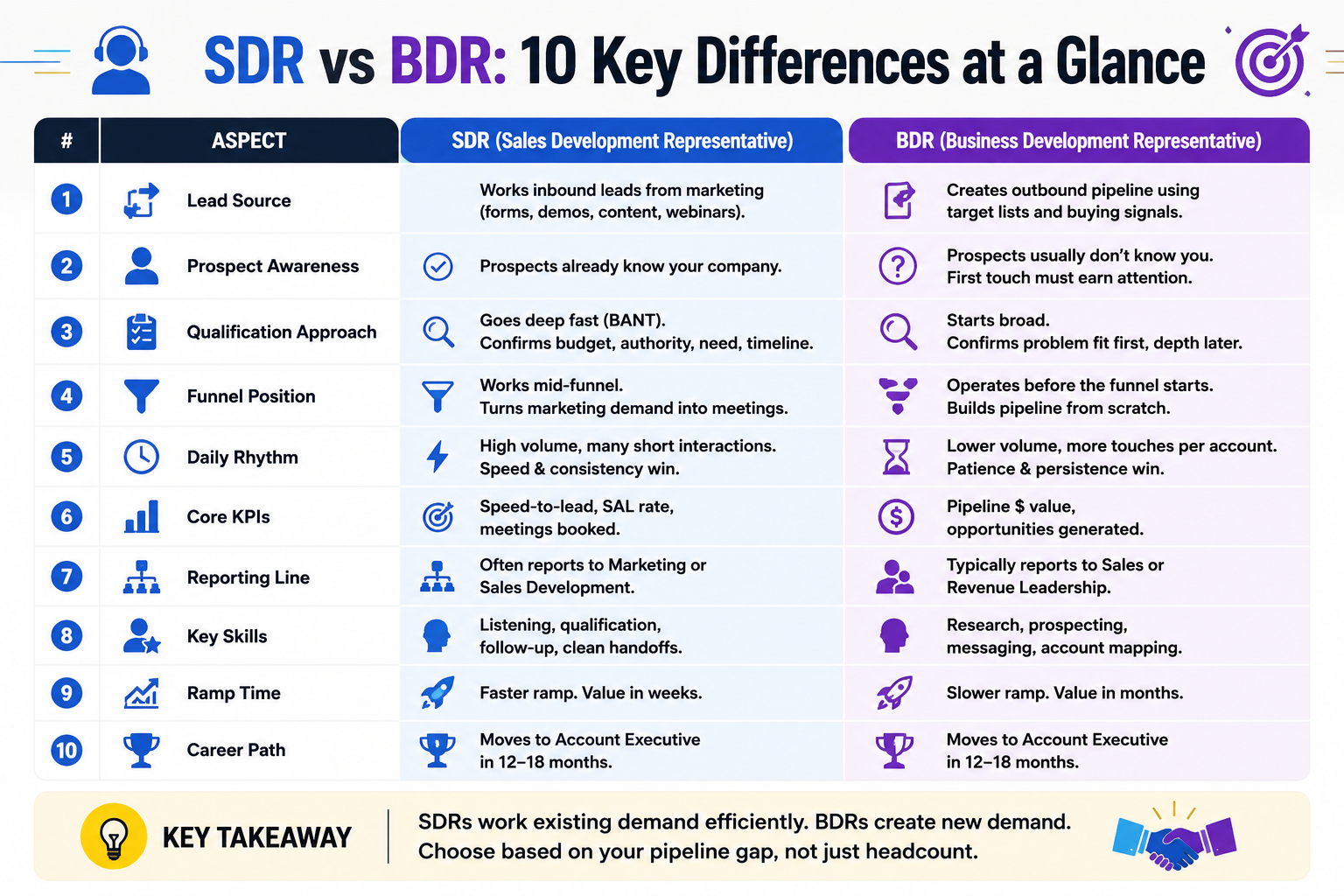
Before the detailed breakdown, here is the SDR vs BDR comparison in one view.
Also Read: How To Identify Who Visits Your Website: Complete Guide
SDR vs BDR: 10 Differences That Change How You Build the Team
The table above gives you the shape. These ten differences explain why the SDR vs BDR choice changes your hiring plan, your tech stack, and your forecast.
1. Lead Direction and Source
An SDR inherits a queue. Demo requests, content downloads, and webinar registrations arrive through marketing, and the work starts the moment a record lands. Demand already exists, so the clock is the only real enemy.
A BDR builds the queue instead. Target lists come from firmographic filters, territory maps, and buying signals rather than campaign output. Every conversation on the board exists because the rep put it there.
2. Prospect Awareness at First Touch
By the time an SDR dials, the prospect recognises your name. That recognition removes a whole layer of friction, so the call moves straight to fit, urgency, and timeline.
Cold outreach carries no such advantage. A BDR often reaches someone who has never encountered your category. The opening line has to earn attention before it earns a meeting, which is exactly why generic messaging fails so visibly.
3. Depth and Order of Qualification
SDRs go deep quickly. Interest is already confirmed, so they can probe budget, authority, need, and timeline. That framework is commonly shortened to BANT, and a clean yes or no usually arrives inside one short call.
BDRs work the other direction. Their first question is broader, closer to whether a problem worth solving exists at all. Depth comes later, once the prospect agrees the topic is relevant. Rushing that sequence produces meetings no AE wants.
4. Position in the Sales Funnel
Sales development sits at the top of the funnel, but the two roles occupy different slices of it. An SDR works the handoff point where marketing demand becomes a sales conversation, which places the role mid-journey.
A BDR operates before the funnel formally begins. There is no lead record to work, no score to read, and no campaign attribution to reference. Everything downstream rests on which accounts they chose to attack.
5. Daily Rhythm, Volume, and Touch Count
Inbound work rewards throughput. An SDR moves through many short interactions in a day and wins by never letting a record sit idle. Speed and consistency beat creativity in this lane.
Outbound rewards patience instead. A BDR spends more time per account, sends more touches per meeting, and accepts a much lower reply rate as normal. Judging one rhythm by the other's standard breaks both teams.
6. Core KPIs and What Each Number Proves
An SDR scorecard proves conversion efficiency. Speed-to-lead shows whether interest is being caught. Sales Accepted Lead rate, meaning the share of handoffs your AEs actually accept, shows whether the filtering works.
A BDR scorecard proves creation capacity. Pipeline dollar value and opportunities generated show whether net-new demand appears at all. Applying one scorecard to both roles is the most common structural mistake in the SDR vs BDR debate.
7. Reporting Line and Org Placement
SDRs frequently report into marketing or a shared sales development function. Their work depends entirely on marketing lead flow, and when the reporting line follows the work, service level agreements get enforced instead of argued about.
BDRs almost always report into sales or revenue leadership. Their output is pipeline, their targets come from territory strategy, and their incentives align naturally with the closing organisation.
8. Skill Profile and Coaching Needs
Coach an SDR on listening, disciplined follow-up, and clean handoffs. The skill you are building is judgement under time pressure, and call review against a fixed qualification standard is the drill that develops it.
Coach a BDR on research, account mapping, and message relevance. The skill you are building is finding a credible reason to reach out today. Multi-threading across a buying committee comes next, once the first contact goes quiet.
9. Ramp Time to First Qualified Pipeline
An SDR contributes fast. Give new rep routing rules, a qualification bar, and a scripted opening, and useful output usually appears within weeks. That speed is why inbound-heavy teams hire this seat first.
Outbound ramps slower by nature. A BDR needs time to learn the market, test messaging, and build enough sequence volume for results to compound. Judging that seat on month-one output produces a false negative almost every time.
10. Career Path and Progression Speed
Both roles feed the same destination. Most reps move into an Account Executive seat within a year to eighteen months. The underlying skills of discovery, objection handling, and pipeline discipline transfer cleanly.
The starting motion still shapes early style. Reps who begin inbound tend to be sharper at fast qualification. Reps who begin outbound tend to be stronger at account strategy and multi-threading. Neither title outranks the other.
SDR vs BDR vs AI Business Developer: The Full Comparison
There is now a third option in the SDR vs BDR conversation, and it does not sit neatly on either side. An AI Business Developer works the traffic already reaching your website. She identifies those people and starts the conversation before a human rep is involved.
The important line in that table is identification level. An SDR only knows what a visitor typed into a form, and a BDR only knows what a purchased database claims. Person-level identification names the visitor whether or not they fill anything in.
Ready to see who is already on your site? Hire Kwin For Free and start with 100 identified leads a month, no credit card required.
Where SDR and BDR Motions Break Down
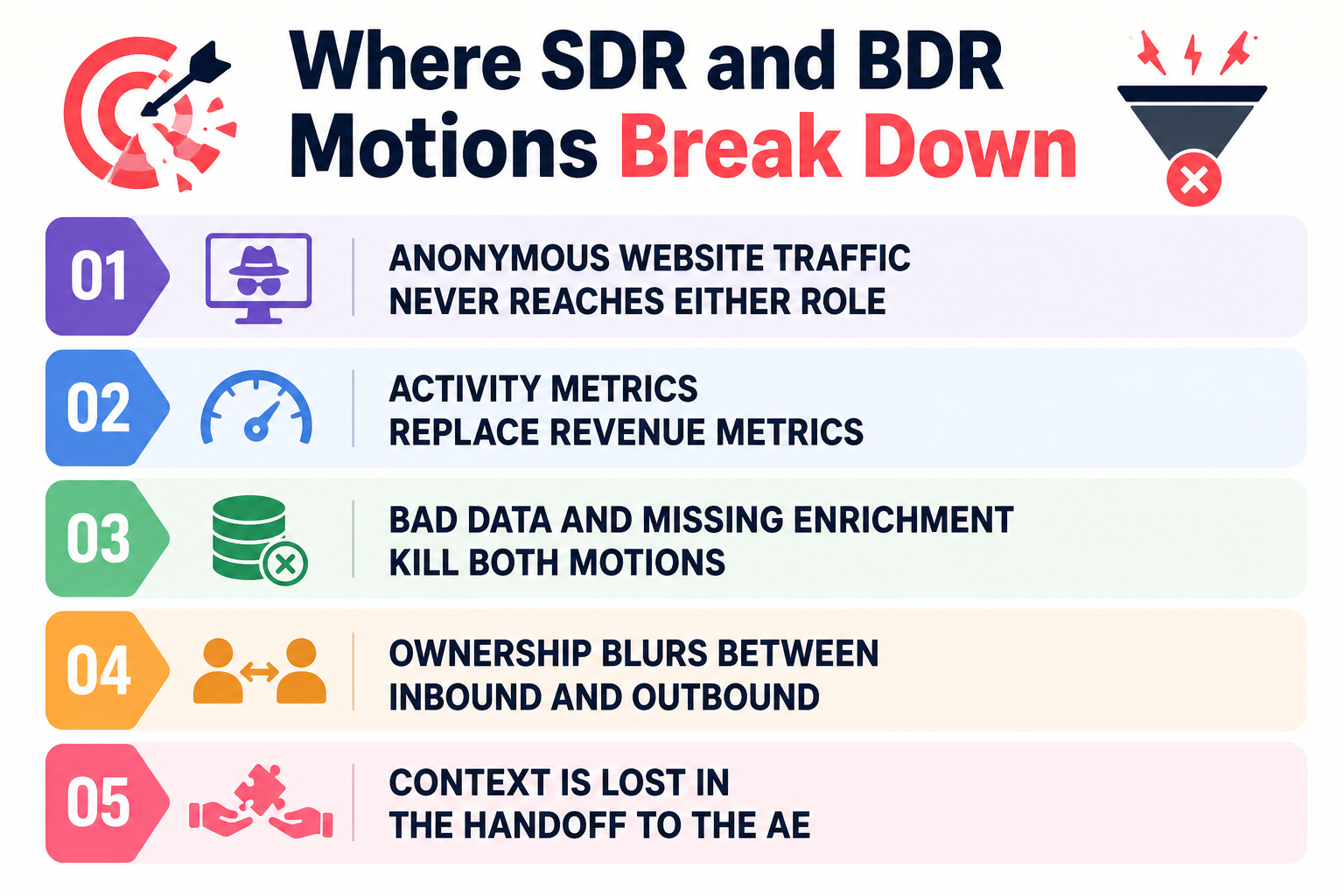
Most sales development problems are not role-design problems. They are input problems, and they show up in the same five places at almost every company.
1. Anonymous Website Traffic Never Reaches Either Role
Your best-fit buyers research quietly, compare options, read your pricing, and leave without identifying themselves. Neither an SDR nor a BDR can work for a person who never appears in the CRM. The benefits of identifying website visitors start with simply seeing that audience.
2. Activity Metrics Replace Revenue Metrics
Dials, sends, and meetings booked are easy to count and easy to game. Reps measured on volume optimize for volume, so soft meetings get pushed through. Track the share of booked meetings that convert into a genuine sales opportunity instead.
3. Bad Data and Missing Enrichment Kill Both Motions
Wrong numbers, bounced emails, and misrouted records waste hours before a single conversation happens. Reps commonly lose a meaningful chunk of every week chasing contact details. Fix targeting and enrichment upstream, because no amount of dialling rescues a bad list.
4. Ownership Blurs Between Inbound and Outbound
When nobody clearly owns each motion, inbound sits unworked while outbound targets go untouched. Both queues suffer quietly, and reviews turn into arguments about whose number it was. Clear ownership is cheaper than any tool bought to compensate.
5. Context Is Lost in the Handoff to the AE
A meeting booked on a half-empty record forces the closer to re-research the prospect or walk in blind. Gartner research shows B2B buyers spend only around 17% of the buying journey with all potential suppliers combined. That sliver of time has to count.
Also Read: Who Is Visiting My Website? Turn Anonymous Traffic into Leads
Which Role Does Your Team Need? SDR, BDR, Both, or Neither
The SDR vs BDR hiring decision comes down to one honest question. Where does your pipeline come from today, and where does it stall?
Signals You Need an SDR First
- Slow lead follow-up: Inbound leads are not being contacted quickly.
- Leads going cold: Good prospects lose interest before your team reaches them.
- AEs doing qualification: Account Executives spend too much time on early-stage leads.
- High inbound volume: Your marketing is generating more leads than the team can handle.
- Conversion is the problem: You have leads, but too few are becoming qualified meetings.
Signals You Need a BDR First
- Thin pipeline: You do not have enough opportunities to hit your sales targets.
- Low inbound volume: Marketing is not generating enough qualified leads.
- New market focus: You are entering a new industry, region, or market.
- Enterprise targeting: You want to reach large accounts that rarely come through inbound.
- Need for outbound: Your team needs someone focused on finding and contacting new prospects.
When You Need Both Motions Running
- Strong inbound and outbound demand: Both channels are generating enough opportunities to need dedicated reps.
- Inbound needs focus: Leads are coming in faster than one rep can handle.
- Outbound needs focus: New prospects also need regular research and outreach.
- Clear ownership: Give each role its own targets and responsibilities.
- Shared standards: Keep the same basic qualification rules across both teams.
When a Hybrid Development Rep Still Works
- Small sales team: One person can manage both inbound and outbound.
- Low lead volume: There are not enough leads to keep separate reps busy.
- Early-stage company: Your sales process is still being tested and refined.
- Flexible workload: The rep can switch between inbound follow-up and outbound prospecting.
- Time to split: Move to separate SDR and BDR roles when lead volume starts increasing.
When Neither Hire Fixes the Real Problem
- Unclear ICP: You do not have a clear picture of your ideal customer.
- Bad data: Your prospect and company information is outdated or incorrect.
- Poor targeting: Your team is reaching the wrong companies or people.
- Anonymous website traffic: Potential buyers visit your site but never become visible leads.
- Fix the basics first: Improve targeting, data, and lead identification before hiring another rep.
5 Common SDR and BDR Mistakes to Avoid
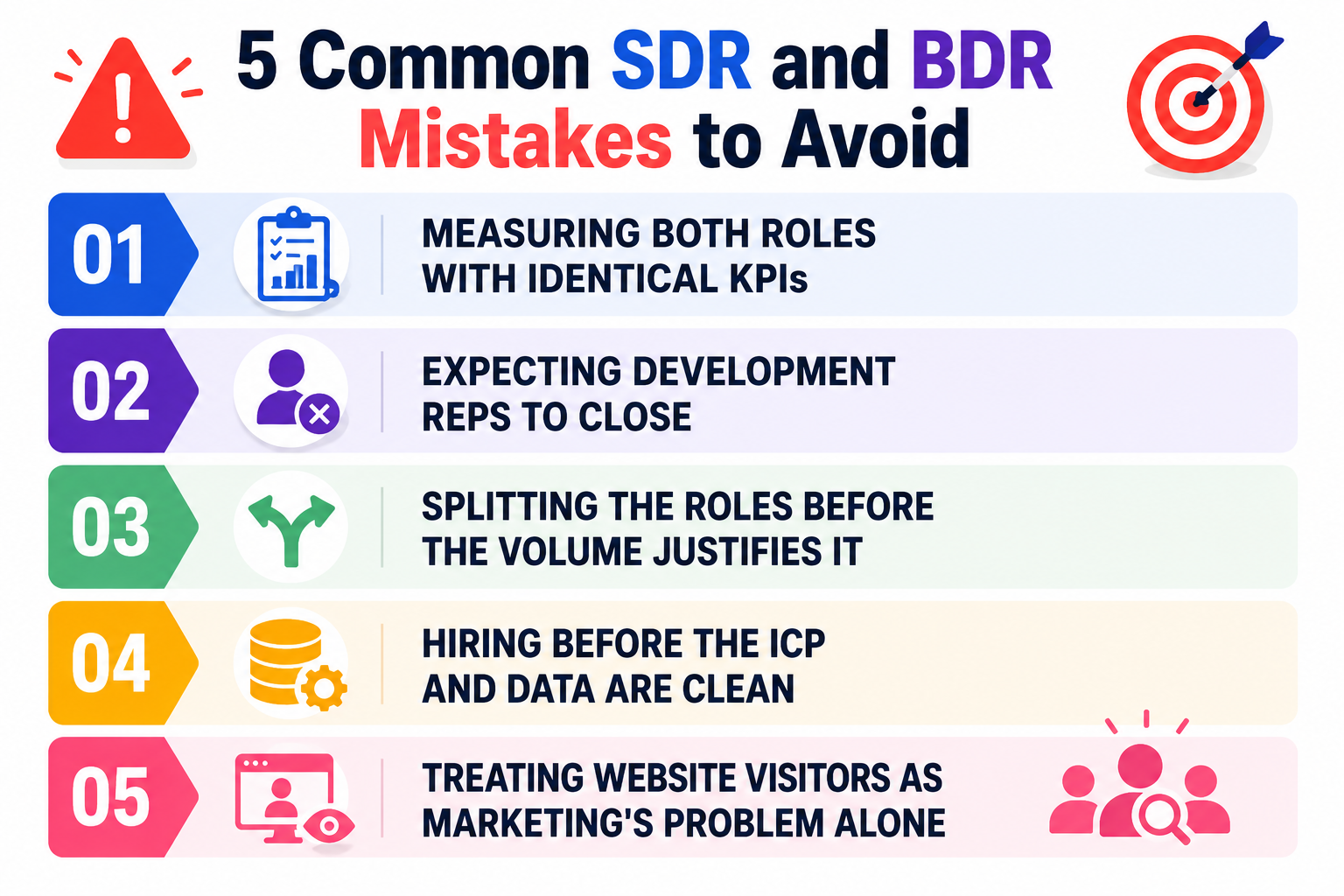
These five errors show up repeatedly, and each one is cheaper to prevent than to unwind.
1. Measuring Both Roles With Identical KPIs
Holding an outbound rep to inbound response times punishes people for doing their actual job. The same applies in reverse. Your scorecard must follow the motion, or your best reps will optimize for the wrong behaviour.
2. Expecting Development Reps to Close
Neither seat is built to run a full sales cycle. Asking them to try dilutes the qualification work you hired them for. Booked meetings and clean handoffs are the deliverable, and closing belongs with your Account Executives.
3. Splitting the Roles Before the Volume Justifies It
Separating inbound and outbound too early leaves both queues underfed and both reps underused. Wait until each motion carries enough volume to fill a week. Premature specialisation creates role confusion and missed service level commitments.
4. Hiring Before the ICP and Data Are Clean
A rep handed a stale list and a fuzzy target profile looks like a bad hire when the real problem sits upstream. Define your Ideal Customer Profile, clean your data, and fix routing first. Then open the seat with confidence.
5. Treating Website Visitors as Marketing's Problem Alone
The people researching you today are sales opportunities, not just traffic statistics. Leaving them unidentified pushes your team back toward cold lists while warm buyers slip away. Identification belongs in the revenue conversation.
Also Read: How To Identify Anonymous Website Visitors: Meet Kwin, Your AI Business Developer
Kwin: The AI Business Developer That Feeds Both Motions
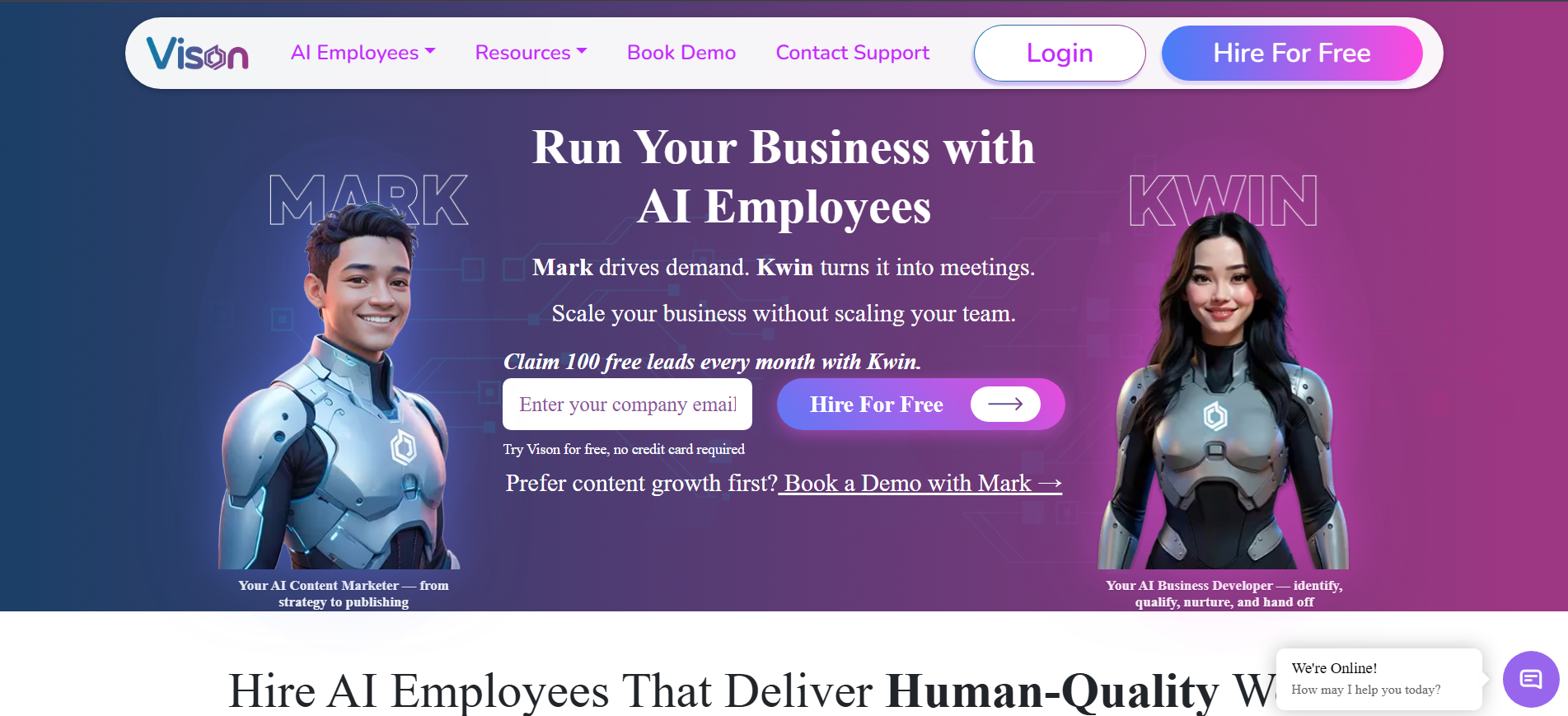
Kwin by Vison AI works as an AI Business Developer that identifies anonymous website visitors, qualifies them, and helps turn high-intent visitors into sales opportunities.
Unlike traditional SDR and BDR workflows that depend on form fills or prospect lists, Kwin works with the traffic already reaching your website. She identifies people and companies, checks their fit and buying intent, and starts personalized outreach when they meet your criteria.
Kwin identifies visitors across 175+ countries and provides details such as name, work email, phone number, LinkedIn profile, job title, industry, revenue, and company information.
Kwin also separates ICP Fit from Purchase Intent, helping your team focus on prospects that are both a good fit and showing buying interest. When a lead meets your set thresholds, Kwin can send personalized emails, manage positive replies, and hand qualified conversations to your team through Slack, CRM, or other connected tools.
Key Features
- Person and company identification: Identify website visitors across 175+ countries.
- Complete contact data: Get names, work emails, phone numbers, LinkedIn profiles, job titles, and company details.
- Behavior tracking: See pages viewed, repeat visits, referral sources, and website activity.
- ICP Fit scoring: Identify visitors who match your ideal customer profile.
- Purchase Intent scoring: Find visitors showing strong buying interest.
- Automated email outreach: Send personalized emails to qualified visitors.
- Positive reply handling: Stop outreach and hand positive conversations to your sales team.
- Native handoff: Send qualified leads to Slack and your CRM.
- Smart filters: Control which visitors Kwin identifies and contacts.
- Five-minute setup: Install Kwin with a website pixel or Google Tag Manager.
Turn Your Website Traffic Into Pipeline
Stop letting ready-to-buy prospects disappear into anonymous traffic.
Hire Kwin For Free and turn your existing website traffic into qualified sales conversations.
Conclusion
SDRs and BDRs solve two different pipeline problems. SDRs qualify the demand already coming in, while BDRs create new demand through outbound prospecting.
The right choice depends on your bottleneck. If good inbound leads are going untouched, hire an SDR. If your pipeline is too thin, a BDR may be the better choice. If both motions have enough volume, build both.
But there is one gap worth fixing before you add headcount. Many potential buyers visit your website, show interest, and leave without filling out a form. Neither an SDR nor a BDR can follow up with someone they cannot see.
That is where Kwin can help. It identifies high-intent visitors, scores their fit and buying intent, and helps turn anonymous website traffic into qualified sales conversations.