
Every day, potential customers visit your website, explore your products, compare your pricing, and leave without filling out a form.
You know they were interested. You just don't know who they were.
That is why so many B2B teams compare website visitor identification tools like 6sense vs ZoomInfo. Both promise to uncover anonymous buyers and help sales teams find more opportunities, but they take very different approaches.
6sense focuses on predicting which companies are ready to buy using AI and buyer intent data. ZoomInfo focuses on giving you verified business contacts so your team knows who to reach out to.
Both are powerful platforms and trusted by thousands of businesses. But which one is best?
In this guide, you'll learn:
- Key differences between 6sense and ZoomInfo
- How each platform works behind the scenes
- Their strengths, weaknesses, and pricing
By the end, you'll know which platform is the right fit for your business.
6sense vs ZoomInfo at a Quick Glance
Before the deep dive, here is how 6sense vs ZoomInfo stack up side by side:
What Is 6sense?
6sense is an AI-powered account-based marketing (ABM) platform that helps B2B sales and marketing teams find companies that are likely to buy.
Instead of waiting for someone to fill out a form or request a demo, 6sense analyzes buyer behavior and online signals to identify businesses that are actively researching products like yours. This helps your team focus on the accounts that are most likely to become customers.
Pros
- Predictive intent scoring: Ranks accounts by buying stages, so teams chase the warmest deals first.
- Strong ABM orchestration: Coordinates ads, email, and sales around target accounts in one place.
- Trained on your data: The model learns from your own and lost deals for sharper predictions.
Cons
- Weaker contact data: Reviewers report inaccurate emails and stale phone numbers.
- Slow, complex setup: Full deployment can take 60+ days and needs dedicated admins.
- Built for enterprise budgets: Smaller teams rarely use enough of the platform to justify the cost.
What Is ZoomInfo?
ZoomInfo is a B2B sales intelligence platform best known for its large database of verified business contacts and company information.
It helps sales and marketing teams find decision-makers, access contact details like work emails and phone numbers, and reach the right prospects faster.
Along with its contact database, ZoomInfo also offers buyer intent, company insights, and outreach tools to support lead generation and sales.
Pros
- Largest contact database: Deep, verified coverage of business contacts and direct dials.
- Fast to deploy: Teams often go live in under three weeks with little training.
- Broad integrations: Connects with a very wide range of CRM and sales tools.
Cons
- Data decays quickly: Contacts who changed jobs often still show as current.
- Weak outside North America: Global coverage drops sharply in accuracy.
- Costly, rigid contracts: Multi-year auto-renewals and add-ons inflate the real price.
6sense vs ZoomInfo: Head-to-Head on What Matters
Here is how 6sense vs ZoomInfo compare across the ten factors that decide most deals:
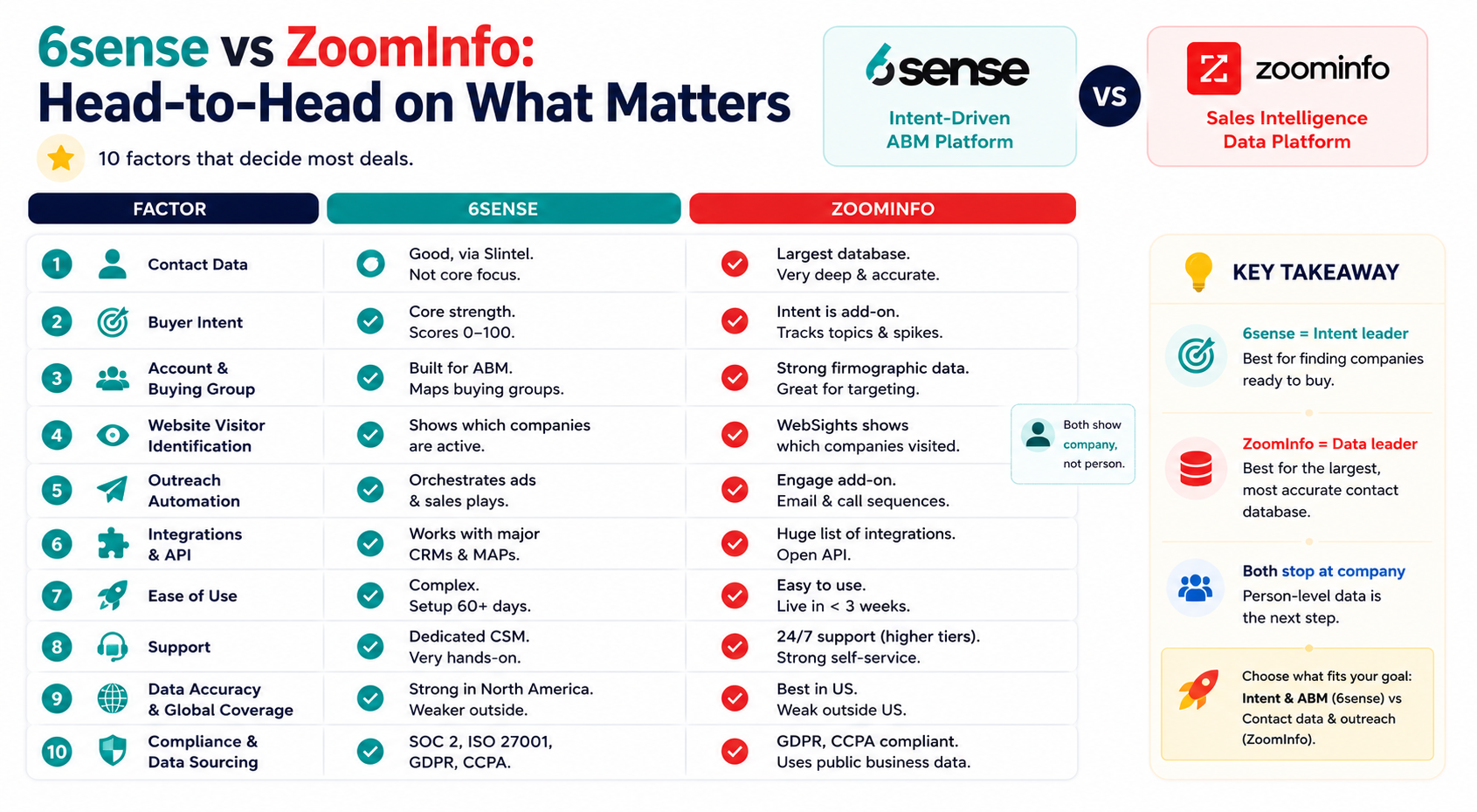
1. Contact Data and Database Depth
6sense carries a contact layer, much of it built from its Slintel acquisition, yet data depth was never its core promise. Reviewers on public review sites consistently rate its contact accuracy below the specialist database vendors. For 6sense, contacts play a supporting role to the intent engine, not the headline act.
ZoomInfo is the opposite story, because the database is the entire product. It holds the deepest pool of verified business contacts and direct dials in the category, refreshed by a large verification operation. If sheer volume of reachable, accurate contacts is your priority, ZoomInfo is built for exactly that.
2. Buyer Intent Data and Signals
For 6sense, buyer intent data is the whole point. It scores every account from 0 to 100 across five buying stages, blending first-party and third-party signals into one prediction. Intent clearly pays off, with over 85% of companies using it reporting real benefits, per Forrester.
ZoomInfo treats intent as a useful add-on rather than the core engine. Its intent module tracks research topics and surfaces accounts showing a spike in activity, which helps reps prioritize outreach. The signal is real, though it does not run as deep or as predictive as the 6sense model.
3. Account and Buying-Group Intelligence
6sense was designed as an account-based marketing platform from day one. It maps the full buying group inside a target account, then tracks how each stakeholder engages over time. For multi-threaded enterprise deals, that group-level view is genuinely powerful.
ZoomInfo approaches accounts through firmographic depth instead of prediction. You get detailed org charts, company hierarchies, and filters to build precise account lists quickly. It is excellent for targeting, but it does not model buying-group behavior the way 6sense does.
4. Website Visitor Identification: Company Level vs Person Level
6sense handles website visitor identification largely by inference. It reads intent signals and account activity to flag which companies are likely browsing, rather than confirming each visit outright. You learn the account looks active, but not the individual behind the session.
ZoomInfo does it through WebSights, matching website traffic to known company records. That reveals which businesses landed on your site. Yet both tools stop at the company, the crux of person-level vs company-level identification, never naming the individual behind the visit.
5. Outreach Automation and Activation
6sense leans toward orchestration rather than direct sending. It pushes target accounts into coordinated advertising and sales plays across channels, which is strong for programmatic ABM. The catch is that it still needs marketing ops to build and run those plays.
ZoomInfo keeps outreach in a separate paid module called Engage. Once you add it, reps can sequence emails and calls directly from the contact records they pull. It works well, but activation is an extra cost layered on top of the data subscription.
6. Integrations and API
6sense connects cleanly with the major CRMs and marketing automation platforms most teams already run. Coverage of mainstream tools is solid, and syncs stay reliable for the common stack. It simply supports fewer of the long-tail or niche integrations.
ZoomInfo casts a wider net, with one of the broadest integration libraries in the category. It plugs into a very large range of CRM, sales, and marketing tools, backed by open API access. For an unusual or heavily customized stack, that breadth gives you more room to work.
7. Ease of Use and Implementation
6sense is the heavier lift of the two. Full deployment often runs past 60 days and needs dedicated admins to configure models and read the scoring. The payoff is real for enterprises, but time-to-value is slow.
ZoomInfo is far quicker to stand up. It is search-driven and familiar, so teams frequently live in under three weeks with minimal training. If you need results inside the current quarter, ZoomInfo gets there faster.
8. Customer Support and Onboarding
6sense earns real praise for its human support. Customers highlight hands-on customer success managers who stay involved well past the initial onboarding. For a platform this complex, that ongoing guidance genuinely matters.
ZoomInfo leans on scale and self-service instead. Higher tiers include round-the-clock support, backed by a deep knowledge base and training library. It is responsive, though it feels less personal than a dedicated success manager.
9. Data Accuracy and Global Coverage
6sense inherits the same regional pattern as most US-built platforms. Its account and contact coverage is strongest in North America and thins as you move into EMEA, APAC, and LATAM. Reviewers regularly flag weaker international data as a real limitation.
ZoomInfo is the benchmark for US business data, and noticeably weaker outside it. Global teams report wrong titles, missing direct dials, and stale records across non-US regions. The database is deep where it is deep, and shallow where it is not.
10. Compliance and Data Sourcing
6sense takes compliance seriously, holding major security certifications and honoring GDPR and CCPA, the US privacy law that gives people control over their personal data. Its model leans on business and intent signals rather than sensitive personal records. For regulated buyers, that posture is reassuring.
ZoomInfo maintains a comparable compliance stack with clear data-handling and opt-out practices. The stronger tools here, ZoomInfo included, work from publicly available business data rather than private personal information. That keeps person-level identification defensible for global teams.
Now that you have seen how 6sense vs ZoomInfo compare feature by feature, let us look at what each one actually costs.
6sense vs ZoomInfo Pricing: What You'll Actually Pay
Neither 6sense nor ZoomInfo publishes fixed pricing on its website. To get an exact quote, you'll need to speak with their sales team. The final price depends on your team size, features, and usage.
6sense Pricing
6sense is one of the more expensive platforms in the market. Most businesses pay between $40,000 and $100,000+ per year, depending on the number of accounts, predictive AI features, advertising capabilities, and contract size.
Pricing is based on custom annual or multi-year agreements. It also uses a credit system, so your available credits and selected features affect the final cost.
If you want to try the platform first, 6sense offers a free Sales Intelligence plan with 50 credits per month.
Also Read: 6sense Alternatives: Top Tools for Website Visitor Identification.
ZoomInfo Pricing
ZoomInfo is generally more affordable than 6sense but is still considered a premium sales intelligence platform. Pricing typically starts at around $15,000 per year.
Your total cost increases as you add more users, database credits, and products like SalesOS, MarketingOS, TalentOS, Engage, or Enrich.
ZoomInfo also offers a free trial or limited free tier so businesses can test the platform before committing.
The Gap Both 6sense and ZoomInfo Leave Open
After comparing 6sense and ZoomInfo, one thing becomes clear.
Both platforms help you identify companies that are interested in your business. But neither can reliably tell you which actual person is visiting your website right now with contact details you can use immediately.
There are a few other limitations too:
- Limited global coverage: Both platforms perform best in North America. If you get visitors from other countries, the data is often less accurate.
- High pricing: Annual contracts usually cost thousands of dollars and can be difficult for small and growing businesses to justify.
- Manual work: Even after finding a potential buyer, your team still has to search for contacts, start outreach, and follow up themselves.
That leads to an important question.
Is identifying a company enough, or do you need to know the real person behind the visit and start the conversation while they're still interested?
That's the problem Kwin was built to solve.
Meet Kwin (Vison AI): The AI Business Developer That Closes the Gap
Kwin is the AI Business Developer from Vison AI, and she works differently from every tool in the 6sense vs ZoomInfo debate. Rather than hand you a dashboard to query, she identifies your visitors, qualifies them, nurtures them, and hands off the hot ones on autopilot.
How Kwin Identifies, Qualifies, Nurtures, and Hands Off
Kwin works like an AI Business Developer that helps you turn website visitors into sales opportunities automatically.
Step 1: Identifies visitors
After you install a small tracking pixel on your website, Kwin identifies both the company and the person visiting your site. She can find details like name, work email, phone number, LinkedIn profile, company, industry, and location for 60% to 70% of visitors across 175+ countries.
Step 2: Qualifies leads
Kwin checks whether each visitor matches your ideal customer and whether they are likely to buy. She only focuses on the best leads.
Step 3: Starts the conversation
Kwin automatically sends personalized emails from your company's email address, helping you connect with potential customers while they are still interested.
Step 4: Hands over the lead
When someone replies or is ready to buy, Kwin sends your team the conversation and a short summary through email, Slack, or your CRM, so you can take over at the right time.
What Makes Kwin Different from 6sense and ZoomInfo
What sets Kwin apart is not a longer feature list. It is what she does with what she finds, turning inbound into B2B lead generation that runs itself.
- Real people, not just accounts: Where 6sense predicts accounts and ZoomInfo lists contacts, Kwin identifies the actual person and books the meeting.
- True global reach: Kwin identifies visitors across 175+ countries, while both rivals lean US-centric.
- Publicly available business data: She works from public business signals, not sensitive personal records.
- Full compliance stack: SOC 2 Type II, GDPR, CCPA, ISO 9001:2015, and ISO 27001:2022.
- One proven workflow, live today: She runs identify, qualify, nurture, and handoff end to end. Custom workflows and LinkedIn outreach are in development.
Also Read: How To Identify Anonymous Website Visitors: Meet Kwin, Your AI Business Developer
Kwin vs 6sense vs ZoomInfo: Feature Comparison
Here is how Kwin stacks up against both, feature by feature.
Stop letting hot visitors leave unnamed. Put Kwin to work identifying and converting your traffic on autopilot.
Book a Free Demo (No credit card required)
Now you have seen how Kwin closes the gap; let us make the final call in the 6sense vs ZoomInfo decision.
How to Choose the Right Tool for Your Team
The right pick comes down to how your team sells. Here is the simple decision.
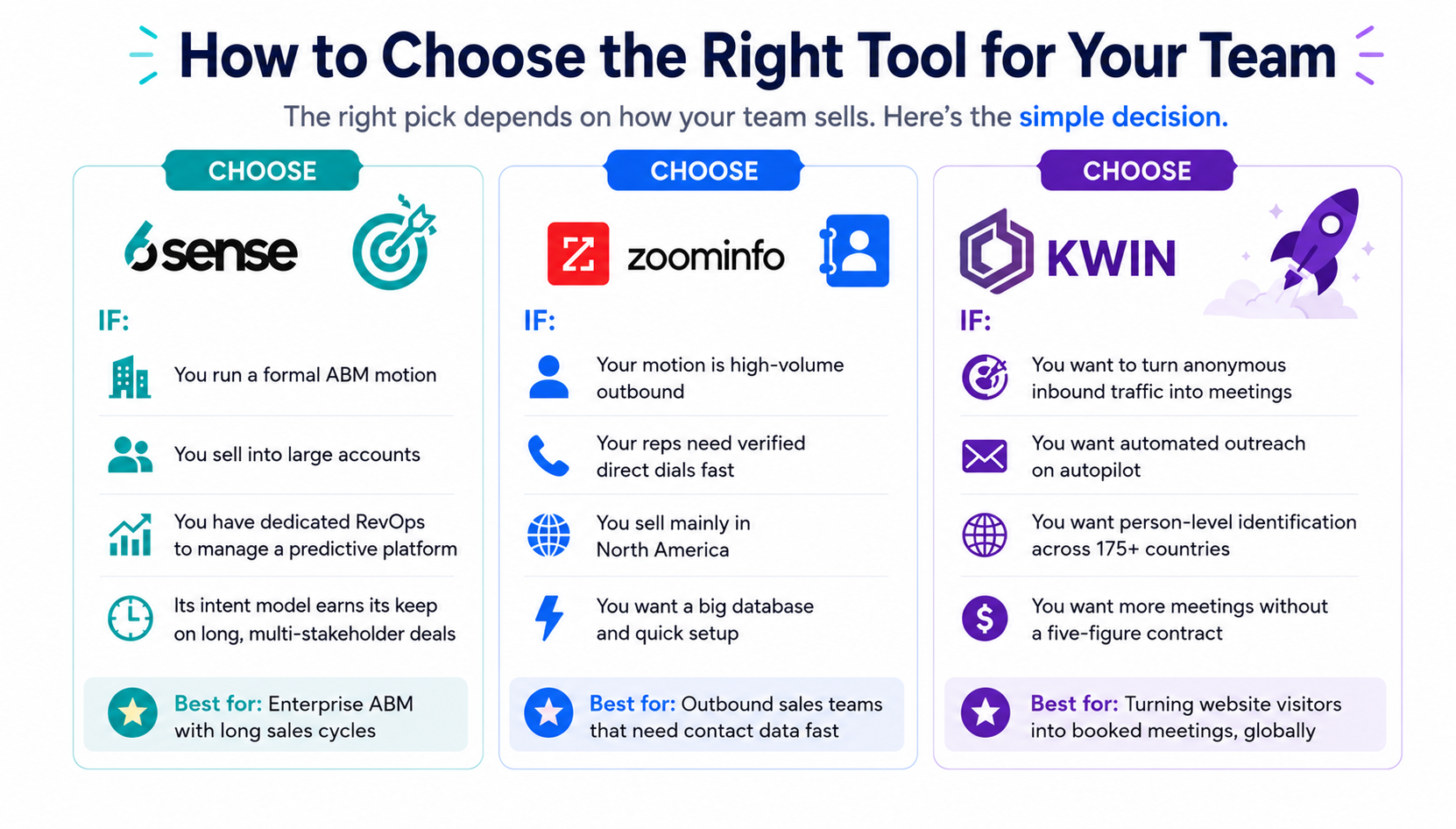
- Choose 6sense if: You run a formal ABM motion, sell into large accounts, and have dedicated RevOps to manage a predictive platform. Its intent model earns its keep on long, multi-stakeholder deals.
- Choose ZoomInfo if: Your motion is high-volume outbound into North America, and your reps need verified direct dials fast. You want a big database and quick setup more than predictive scoring.
- Choose Kwin if: You want to turn anonymous inbound traffic into booked meetings without a five-figure contract. Kwin identifies the real person, powers person-level ABM campaign visitor identification, and hands off hot leads across 175+ countries, on autopilot.
Conclusion
Both 6sense and ZoomInfo are powerful platforms, but they are built for different goals. 6sense is best for finding companies that are ready to buy, while ZoomInfo is best for finding business contacts.
However, both mainly identify companies, not the actual person visiting your website. If your goal is to turn anonymous website visitors into qualified leads, you'll likely need a solution that goes a step further.
We hope this guide has helped you understand the differences between 6sense and ZoomInfo and choose the right platform for your business.
Hire Kwin For Free and turn anonymous traffic into booked meetings across 175+ countries, with no credit card required.