
A full sales pipeline does not always mean you have good leads.
You may have plenty of leads, meetings, and sales opportunities. But if many of them are not a good fit, your sales team wastes time chasing deals that are unlikely to close.
That is why B2B lead qualification is important.
A good qualification process helps your team quickly identify which leads are worth pursuing and which ones should be nurtured or removed.
But there is another challenge. Many B2B buyers never fill out a form. They quietly visit your website, check your pricing, compare solutions, read case studies, and leave. Your CRM may never know they were there.
That means a good qualification process should look beyond form fills and identify buying signals across the entire website journey.
In this guide, you will learn how to build a practical B2B lead qualification process, including qualification criteria, scoring models, frameworks, questions, automation, and ways to identify buyers who stay anonymous.
By the end, you will know which leads to pursue, which to nurture, and which to leave behind.
What Is B2B Lead Qualification?
B2B lead qualification is the process of checking whether a potential customer is worth your sales team’s time.
It helps you understand if the lead is a good fit, has a real problem you can solve, is interested in your solution, and has the ability or plan to buy.
In simple words, it helps your sales team focus on the right leads instead of wasting time on prospects who are unlikely to become customers.
5 Lead Types Every Revenue Team Must Define
Before your B2B lead qualification process can work, your team needs to understand the different types of leads and what each one means.
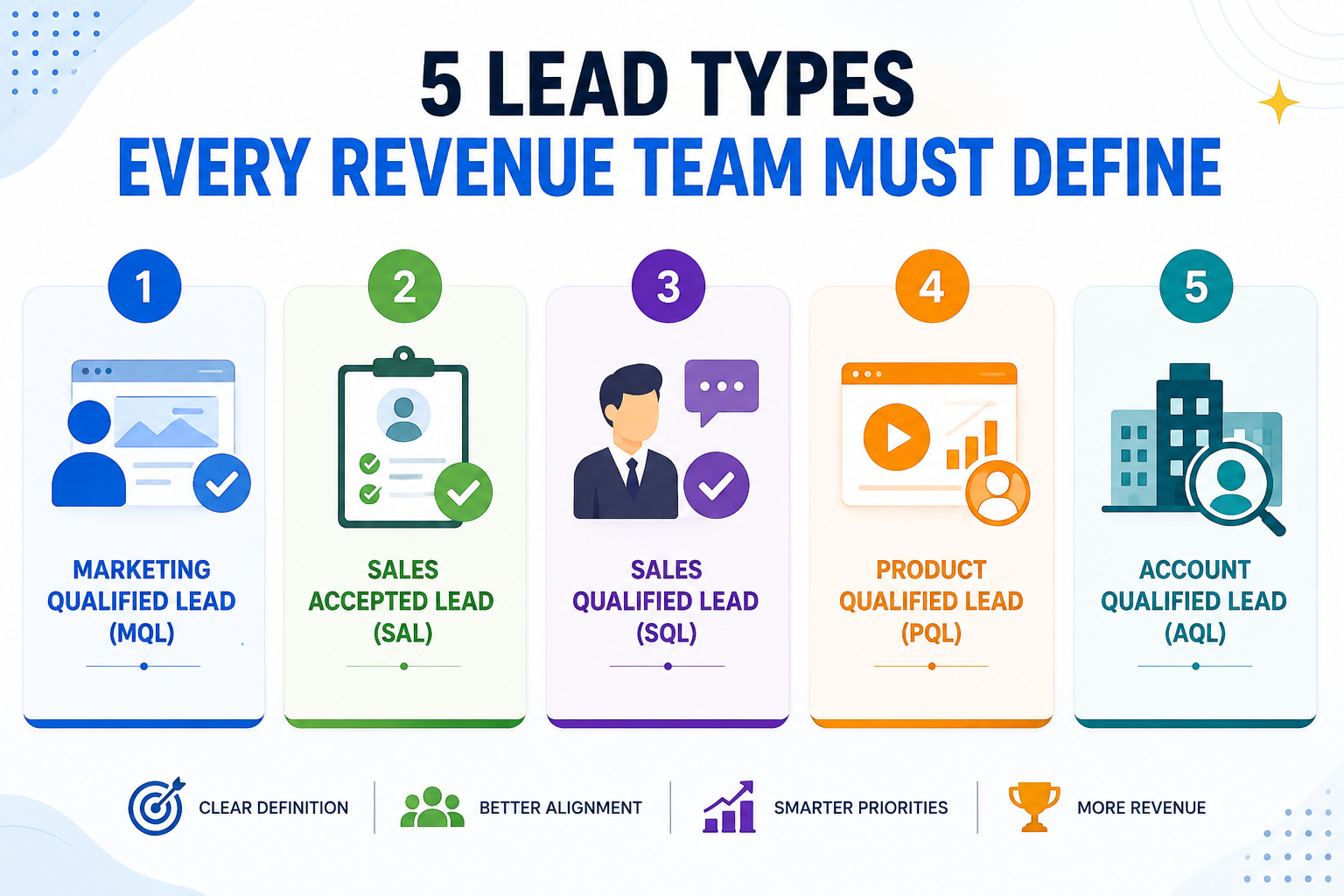
1. Marketing Qualified Lead (MQL)
An MQL is a lead that has shown interest in your content or website and matches your basic customer profile. They are interested but may not be ready to speak with sales yet.
2. Sales Accepted Lead (SAL)
A SAL is an MQL that a sales rep has reviewed and accepted for follow-up. It means sales believes the lead is worth contacting and exploring further.
3. Sales Qualified Lead (SQL)
An SQL is a lead that sales has spoken with and confirmed as a potential sales opportunity. They have a real problem, a clear need, and a possible path to buying.
4. Product Qualified Lead (PQL)
A PQL is a user who has already tried your product through a free plan or trial and is actively using it. Their product activity shows they are getting value and may be ready to become a paying customer.
5. Account Qualified Lead (AQL)
An AQL is a good-fit company showing strong interest in your business without filling out a form. For example, they may repeatedly visit your pricing or product pages, making them worth identifying and contacting.
Build Your Ideal Customer Profile Before You Qualify Anything
You cannot qualify against a target you have not defined. A useful ICP tells reps who to pursue, who to skip, and exactly what to confirm before spending time on outreach.
1. Start From Closed-Won Data, Not a Blank Page
Blank-page workshops produce generic profiles that describe everyone and help nobody. Pull your closed-won accounts, then compare them against closed-lost and no-decision deals. If your reps describe your best customers better than your CRM can, your ICP is too loose.
2. Layer Firmographics, Technographics and Use-Case Fit
Industry, headcount, and revenue band give you a baseline, but rarely explain why one account closes and a similar one stalls. Add the tools they already run, because a tech stack reveals pain sharply. Then record each winner's actual problem.
3. Split Your ICP Into Tier 1 and Tier 2
Not every fit is equal, so treating all matches identically wastes your best reps on average accounts. Tier 1 covers segments with your strongest win rates and lowest churn. Tier 2 covers adjacent industries that still convert, just slower and with more education.
4. Map the Buying Committee, Not Just the Job Title
Complex B2B deals routinely involve six to ten stakeholders, according to Forrester research on buying groups. Your ICP should name the roles you expect: champion, economic buyer, technical evaluator, end user, and blocker. That stops reps confusing access with authority.
5. Write Exclusion Rules and Refresh Them Quarterly
Most teams document who they want and never document who wastes their time. Write those exclusions down, whether that means a size floor, an unservable region, or a segment that always stalls. Then revisit the profile quarterly.
Also Read: Proven B2B Lead Generation Strategies
7 B2B Lead Qualification Frameworks That Still Work
Frameworks matter because reps under pressure default to gut feel. Gut feel overweights politeness and underweights dealing with reality, so here are the seven structures high-performing teams still run.
Framework Comparison at a Glance
1. BANT: Budget, Authority, Need, Timeline
BANT helps sales teams quickly check whether a lead is ready to buy. It looks at budget, decision-making power, business need, and buying timeline. It works well for simple deals with shorter sales cycles.
2. CHAMP: Challenges, Authority, Money, Prioritization
CHAMP starts with the customer's problem instead of asking about the budget first. It helps sales teams understand what the buyer is trying to fix, how important the problem is, and who is involved in the decision.
3. MEDDICC: For Complex Enterprise Deals
MEDDICC is useful for large and complex sales. It helps reps understand the buyer's goals, decision process, key decision-makers, internal champions, and competition. It takes more time but can reduce surprises in big deals.
4. ANUM: Authority, Need, Urgency, Money
ANUM starts by finding out who has the authority to make the purchase. Then it looks at the customer's need, urgency, and budget. It works well for outbound sales teams that need to reach the right decision-maker quickly.
5. FAINT: Funds, Authority, Interest, Need, Timing
FAINT works when a company has money available but has not set a specific budget for your solution. It focuses on finding available funds, building interest, understanding the need, and creating a reason to act.
6. GPCTBA/C&I: Goals, Plans, Challenges, Timeline, Budget, Authority, Consequences and Implications
This framework looks deeply at the customer's goals, plans, problems, budget, and decision process. It also asks what could happen if the problem is not solved. It works best for large deals that need detailed discovery.
7. SPICED: Situation, Pain, Impact, Critical Event, Decision
SPICED helps sales teams understand the customer's current situation, problem, and business impact. It then identifies the event that is pushing them to act and how they will make the final decision. This makes it easier to understand how serious and timely the opportunity really is.
Complete B2B Lead Qualification Checklist: 12 Criteria
This is the working checklist. Run it on every discovery call, and run a version of it on every identified visitor before a rep ever dials.
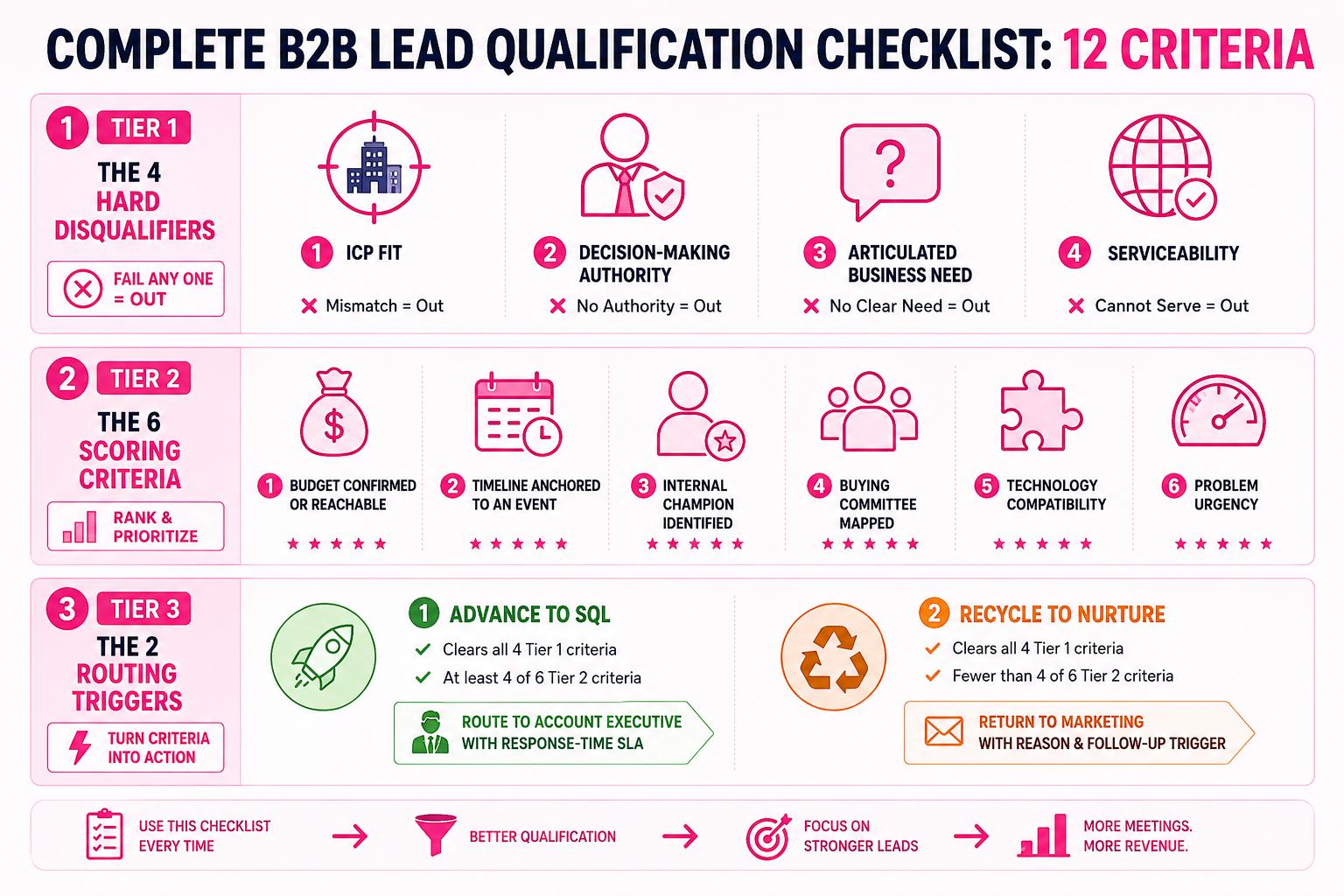
1. Tier 1: The 4 Hard Disqualifiers
These four are binary. Fail any one and the lead leaves your active pipeline, because no amount of engagement changes the underlying math.
- ICP fit: Does the company match your target industry, size, region, and technology environment?
- Decision-making authority: Can this contact approve, influence, or introduce you to whoever signs?
- Articulated business need: Can they describe a specific problem your product solves, in their own words?
- Serviceability: Can you legally and practically deliver to this company in their region and language?
2. Tier 2: The 6 Scoring Criteria
These six do not disqualify on their own. They rank the leads that already cleared Tier 1, so reps work the strongest accounts first.
- Budget confirmed or reachable: Has money been allocated, or is there a credible route to approval?
- Timeline anchored to an event: Is a renewal, deadline, audit, or executive initiative forcing a decision?
- Internal champion identified: Is somebody inside the account actively advocating for change?
- Buying committee mapped: Do you know the economic buyer, the evaluator, and the likely blocker?
- Technology compatibility: Does your product integrate with the systems they already depend on?
- Problem urgency: Is this a critical failure they live with daily, or a mild annoyance they tolerate?
3. Tier 3: The 2 Routing Triggers
Tier 3 converts the checklist into action, which is the step most teams skip entirely. Without a trigger, criteria become a filing exercise instead of a routing decision.
- Advance to SQL: The lead clears all four Tier 1 criteria and at least four Tier 2 criteria. Route it to an account executive with a response-time SLA attached.
- Recycle to nurture: The lead clears Tier 1 but meets fewer than four Tier 2 criteria. Return it to marketing with a documented reason and a follow-up trigger.
How to Run the Checklist on a Lead Who Filled Out a Form
Start with the easy population. This is the B2B lead qualification process for anyone who has already told you who they are.
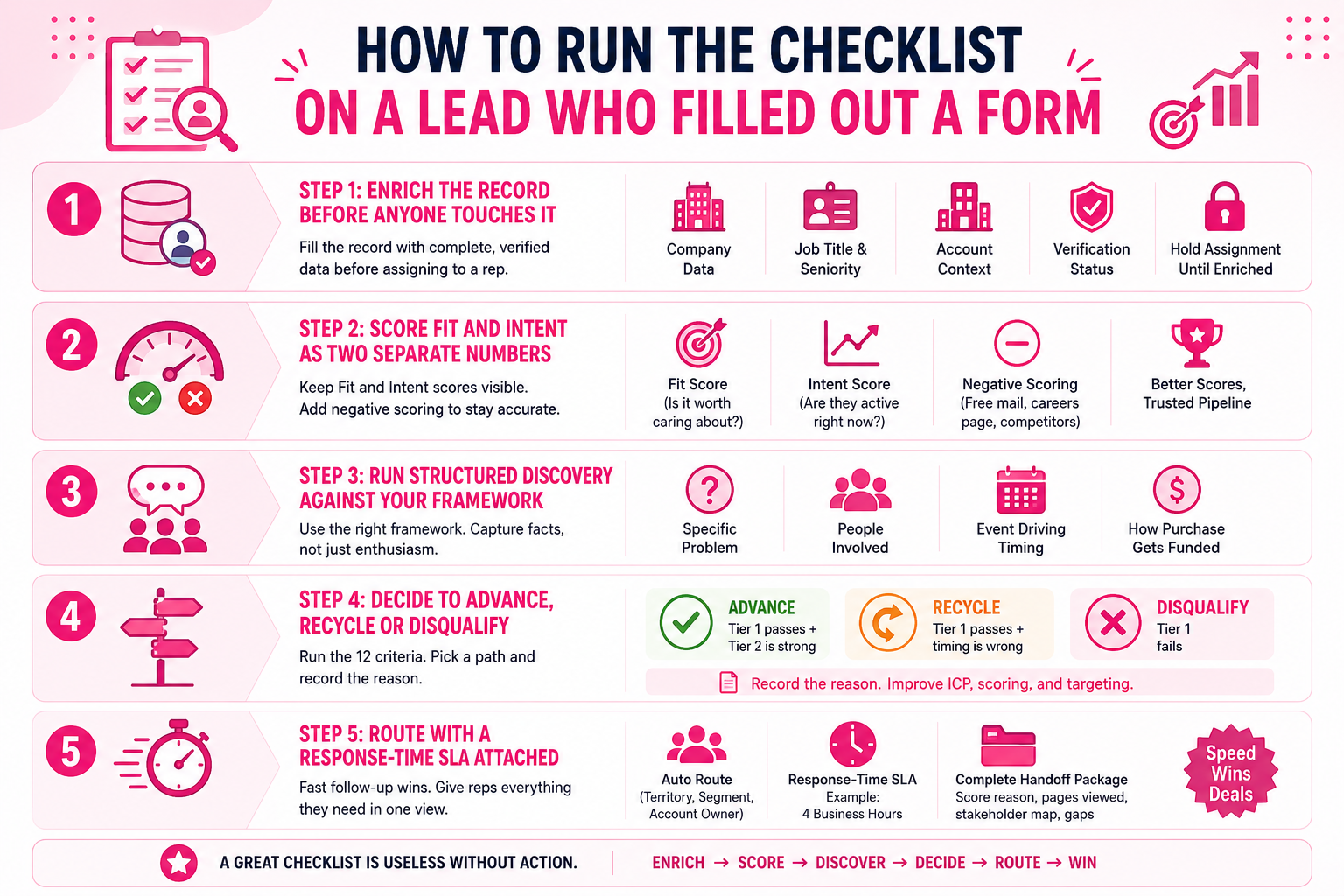
Step 1: Enrich the Record Before Anyone Touches It
Scoring a thin record creates false precision, and false precision destroys rep trust fast. An email address alone tells you nothing about company size, seniority, or buying authority.
Before any rep sees the lead, append company data, job title and seniority, account context, and verification status. Then set a rule that holds assignments until those fields are actually filled.
The principle is simple. Nobody on your team should spend a discovery call asking questions your system could have answered beforehand.
Step 2: Score Fit and Intent as Two Separate Numbers
One blended score hides the exact thing you need to see. A perfect-fit account with no activity needs nurturing, while an active poor-fit account needs suppressing.
Keep both numbers visible on the record. Fit answers whether this account is worth caring about at all, and intent answers whether they are evaluating right now.
Add negative scoring too. Deduct points for free-mail domains, careers page visits, and competitor traffic, or your scores will inflate until nobody trusts the queue.
Step 3: Run Structured Discovery Against Your Framework
Now the human work starts, and structure is what stops it feeling like an interrogation. Pick the framework that matches this deal's size, then let the conversation move naturally around it.
Leave that call with four things written down. The specific problem, the people involved, the event driving timing, and how this kind of purchase gets funded internally.
Listen for concrete details: a missed target, a recent reorganisation, a tool quietly failing. Vague enthusiasm is not evidence, and it will not survive your next pipeline review.
Step 4: Decide to Advance, Recycle or Disqualify
Every qualification conversation must end in a documented decision, never a vague follow-up task. Ambiguity here is exactly what fills pipelines with accounts nobody wants to close out.
Run the lead against the 12 criteria and choose one of three paths. Advance if Tier 1 passes and Tier 2 is strong, recycle if only timing is wrong, disqualify if Tier 1 fails.
Record your reason every single time. Those reasons become the feedback loop that sharpens your ICP, your scoring weights, and your campaign targeting next quarter.
Step 5: Route With a Response-Time SLA Attached
Speed decides whether all this effort converts. Harvard Business Review research found that firms contacting a lead within the first hour qualify it far more often than slower rivals.
Build routing rules that assign by territory, segment, or account ownership automatically, so nothing waits for manual triage. Attach a hard expectation, for example, four business hours on a sales-ready lead.
Make the handoff package complete as well. The receiving rep needs the score reason, pages viewed, stakeholder map, and open qualification gaps in one view.
Qualification Questions That Surface the Truth
Frameworks give you structure, but questions are where B2B lead qualification actually happens. The information you need never changes. Only your framing decides whether the call feels like discovery or an audit.
1. Questions Mapped to Each Qualification Pillar
2. Questions That Expose the Full Buying Committee
Asking who the decision maker is almost always produces a useless answer, because the person in front of you wants to sound important. Ask instead who benefits if this gets solved, and who signs off even informally. Those two reveal champions and blockers.
3. Questions That Test Urgency and the Triggering Event
A stated timeline is a weak signal. A triggering event is a strong one. Ask what is driving the evaluation right now, and what happens internally if the project slips a quarter. Without a renewal or deadline, the urgency is yours, not theirs.
4. How to Ask About Budget Without Killing the Deal
Direct budget questions on a first call disqualify deals that would have closed with a business case behind them. Quantify the cost of the problem first, then ask how the company funds initiatives with a clear return. Your champion leaves better armed internally.
Now that you can run the checklist on form fills, let's do the harder half. Running it on the buyers who never fill anything in.
How to Run the Same Checklist on a Visitor Who Never Filled a Form
The same twelve criteria apply across the same three tiers of B2B lead qualification. The only thing that changes is where the evidence comes from. That single shift unlocks more pipelines than anything else on this list.
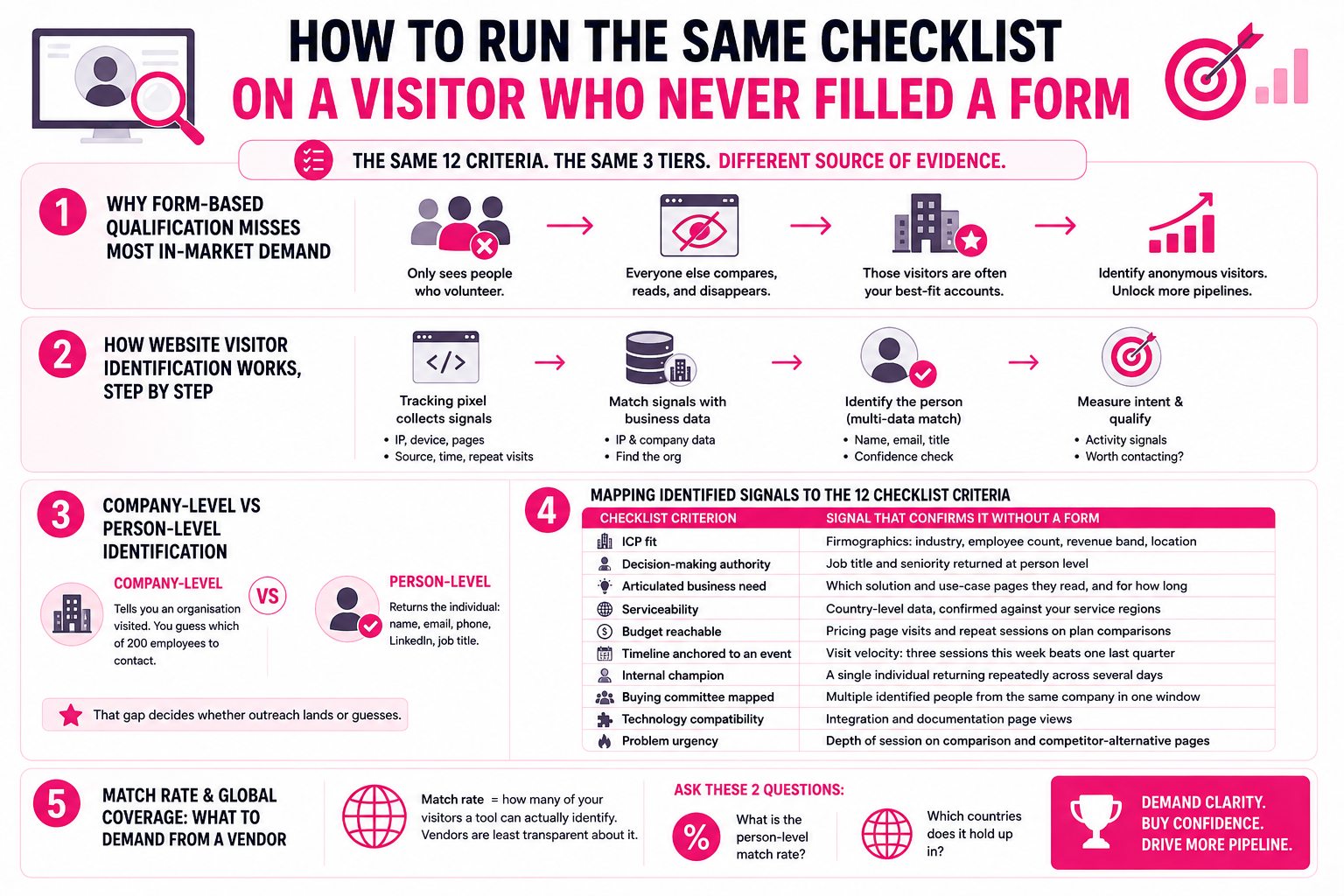
Step 1. Why Form-Based Qualification Misses Most In-Market Demand
Your B2B lead qualification engine only ever sees people who volunteered. Everyone else compares you against a rival, reads your pricing, and disappears without a trace.
Those visitors are frequently your best-fit accounts, because they arrive already deep into evaluation. That is why teams now identify anonymous website visitors rather than waiting on forms.
Step 2. How Website Visitor Identification Actually Works, Step by Step
A visitor identification tool starts by tracking activity on your website. A small tracking pixel collects signals such as IP address, device, pages visited, traffic source, time spent, and repeat visits.
These signals are then matched with business data to identify the company behind the visit. The system uses information such as IP and company details to find the most likely organisation.
Person-level identification goes a step further by matching multiple data points to identify the individual visitor. A confidence check helps remove weak or unreliable matches.
Once the visitor is identified, their website activity can be used to measure buying interest and decide whether they are worth contacting.
Step 3. Company-Level vs Person-Level Identification
Company-level identification tells you an organisation visited, leaving your SDR guessing which of two hundred employees to contact. Person-level identification returns the individual: name, work email, phone number, LinkedIn profile, and job title.
That gap decides whether outreach lands or guesses. Comparing a company-level tool against a person-level one makes the difference obvious within a single week of traffic.
Step 4. Mapping Identified Signals to the 12 Checklist Criteria
Here is the part no qualification guide covers. Every criterion in the checklist has an observable equivalent once you know who visited.
Step 5. Match Rate and Global Coverage: What to Demand From a Vendor
Match rate means how many of your visitors a tool can actually identify, and vendors are least transparent about it. Person-level coverage often collapses the moment your traffic leaves North America.
Ask two questions before you sign anything. What is the person-level match rate, and which countries does it hold up in?
Most Leadfeeder alternatives stop at company level. Kwin identifies 60% to 70% of visitors at person and company level across 175+ countries.
Also Read: ZoomInfo Alternatives: Top Tools for Person-Level Visitor Identification
When to Disqualify and When to Recycle Into Nurture
Not every lead is ready to buy, and not every lead should stay in your sales pipeline. The key is knowing when to walk away and when to give a good lead more time.
1. When Should You Disqualify a Lead?
Disqualify a lead when the company is not a good fit, has no clear problem to solve, has no budget or way to get one, or the contact cannot influence the buying decision.
2. Disqualify or Nurture? Ask One Simple Question
Ask whether the problem is fit or timing. If the company is not a good fit, disqualify it. If it is a good fit but not ready to buy, move it to nurture and follow up later.
3. Do Not Filter Leads Too Quickly
Some leads may need more time, information, or budget before they are ready to buy. Do not reject them too quickly. Give good-fit leads a chance to become ready.
4. Learn From Every Disqualified Lead
Record why each lead was disqualified, such as poor fit, no budget, or no need. These reasons can help your sales and marketing teams improve their targeting and bring in better leads.
Lead Qualification Compliance: What Publicly Available Business Data Means
Compliance is not a legal footnote in B2B lead qualification. It shapes which signals you may use, which regions you can qualify in, and which vendors survive a security review.
1. Publicly Available Business Data vs Sensitive Personal Data
The best identification tools work from publicly available business data: company registrations, professional profiles, work email patterns, and firmographic records. They never touch sensitive personal data.
2. GDPR, CCPA and Qualifying Buyers Outside the US
European and UK buyers often research silently, because consent rules limit contact-level capture early on. That makes behaviour-based qualification more valuable there, not less. If you sell internationally, confirm GDPR and CCPA handling.
3. The Certification Stack to Demand From Any Qualification Vendor
Ask any vendor for evidence rather than assurances. Kwin carries SOC 2 Type II, GDPR, CCPA, ISO 9001:2015, and ISO 27001:2022, and never sells customer data. Treat missing certifications as procurement risk instead of a minor detail.
Also Read: 12 GDPR-Compliant Visitor Identification Tools
7 B2B Lead Qualification Mistakes That Quietly Kill Pipeline
Many sales teams make these mistakes without noticing them. The result is a busy sales team, a full pipeline, and fewer real opportunities.
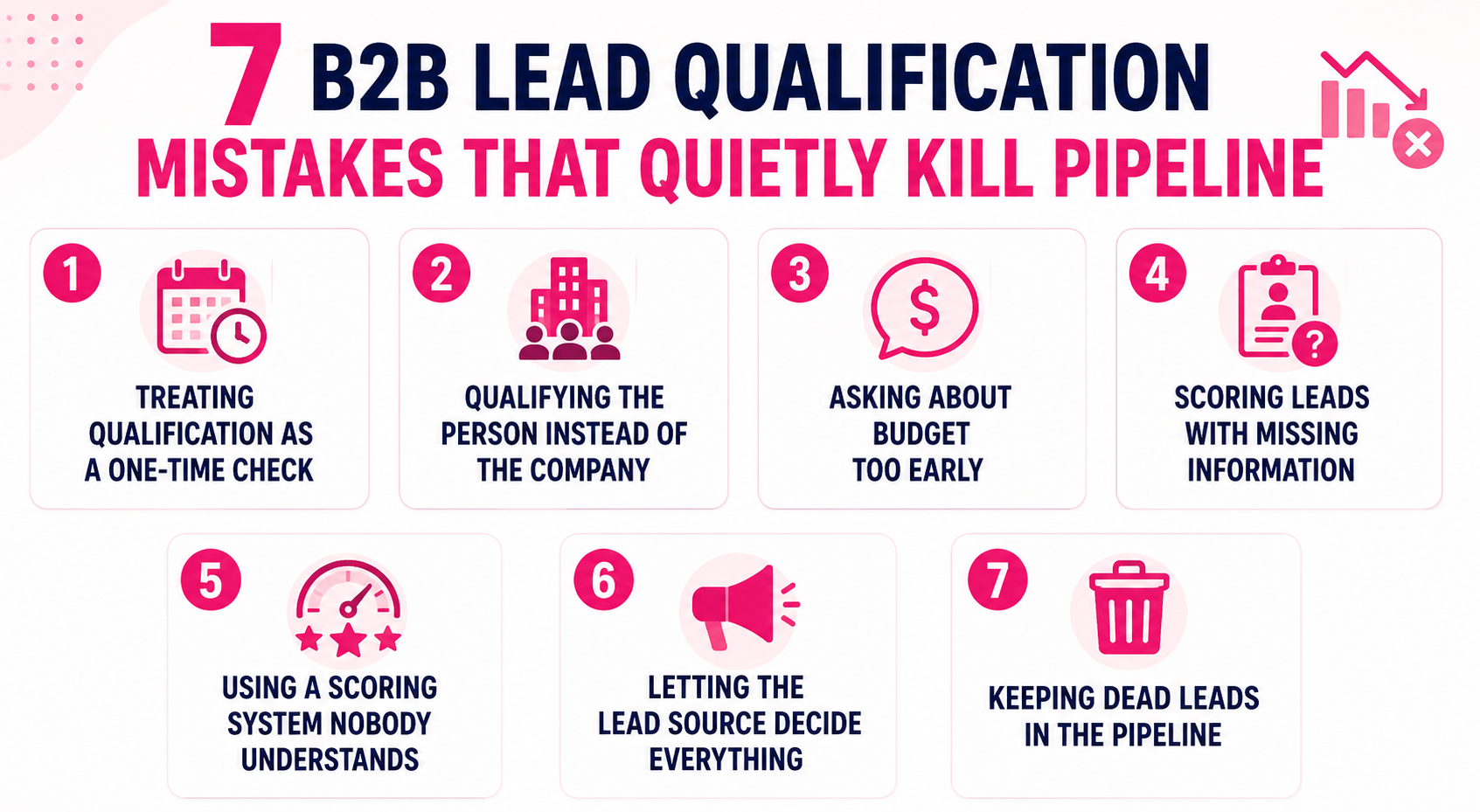
1. Treating Qualification as a One-Time Check
A lead can change over time. A company that was not ready to buy six months ago may have a new budget, new leadership, or a new need today. Review your leads regularly instead of qualifying them only once.
2. Qualifying the Person Instead of the Company
One person liking your product does not mean the company is ready to buy. B2B purchases often involve several people. First, check whether the company is a good fit, then understand who is involved in the buying decision.
3. Asking About Budget Too Early
Starting the first call with "What is your budget?" can make a good prospect lose interest. First, understand their problem and show the value of your solution. Then discuss how they plan to fund the project.
4. Scoring Leads With Missing Information
Do not give a lead a high score just because they opened emails or visited your website. You also need basic information such as company size, industry, job title, and location. Get the important details first, then score the lead.
5. Using a Scoring System Nobody Understands
If your sales team cannot understand why a lead received a certain score, they will stop trusting the system. Keep your scoring rules simple and clear so every rep knows what the score means.
6. Letting the Lead Source Decide Everything
A lead from a webinar, ad, or event is not automatically a good lead. The source tells you where the lead came from, not whether they are ready to buy. Always check fit, need, authority, and buying interest.
7. Keeping Dead Leads in the Pipeline
Some leads will never become customers, but teams often keep them active for too long. This makes the pipeline look bigger than it really is and wastes sales time. Close out leads that clearly have no potential and keep good-fit leads in nurture if they may buy later.
7 Metrics That Prove Your Qualification Process Works
Track these seven metrics to quickly see whether your B2B lead qualification process is working.
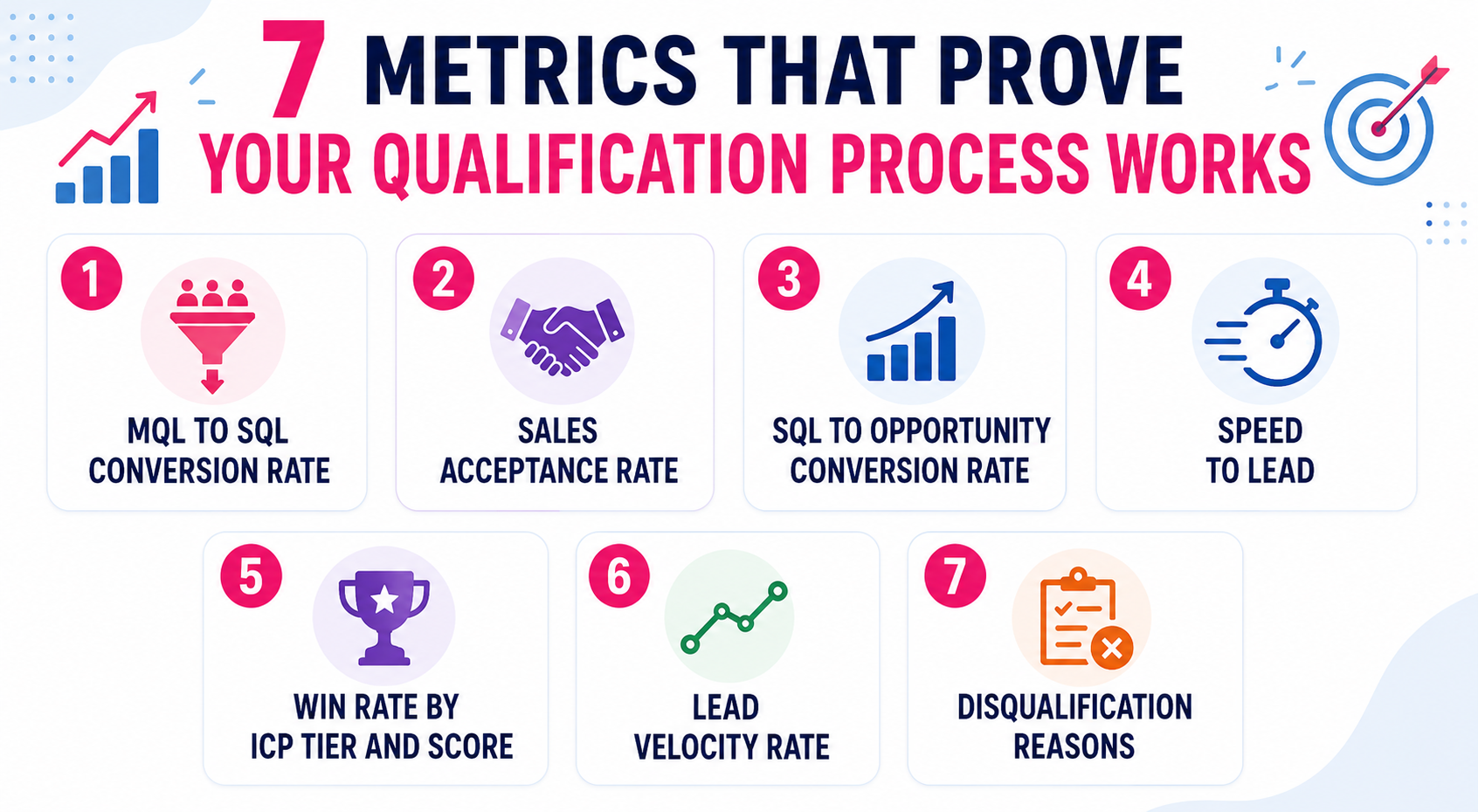
1. MQL to SQL Conversion Rate
This is your clearest signal of whether marketing passes leads to sales that can genuinely work. A low rate means marketing criteria are too loose or sales criteria too strict. Track it by segment, because one industry can drag the average down.
2. Sales Acceptance Rate
Acceptance rate measures how many handed-off leads reps formally take on rather than bounce back. It isolates the handoff itself, separating lead quality from discovery problems. When acceptance drops, your shared definition of qualified has drifted.
3. SQL to Opportunity Conversion Rate
This tells you whether accepted leads survive real discovery or collapse on contact. A weak rate means reps accept leads before criteria are genuinely clear, usually under pipeline pressure. It is the most honest measure of qualification discipline.
4. Speed to Lead
Time from qualification to first contact predicts conversion better than almost any operational metric. McKinsey's B2B Pulse research found around 50% of B2B buyers abandon a vendor after a poor buying experience. Slow follow-up is that experience.
5. Win Rate by ICP Tier and Score Band
Segmenting win rate by tier and score band validates whether your model actually predicts revenue. If Tier 2 accounts win as often as Tier 1, your tiering is decorative. This metric tells you when to reweight criteria.
6. Lead Velocity Rate
Lead velocity tracks whether your pool of qualified leads grows month over month. It is forward-looking, so it warns you about next quarter while everyone argues about this one. Falling velocity with stable traffic signals a qualification bottleneck.
7. Disqualification Reasons by Segment
Disqualification reasons are the most underused dataset in most CRMs. Grouped by segment and channel, they show whether your ICP is wrong or a campaign is buying the wrong audience. Review them quarterly and update the profile.
How Kwin Qualifies Every Visitor Before Your Team Says Hello
Most qualification tools hand you a list and leave the work with your team.
Kwin, the AI Business Developer from Vison AI, runs the whole sequence herself. She identifies, qualifies, nurtures, and hands off, so your reps meet buyers who already cleared the bar.
1. Identify: Find the Person Behind the Visit
Kwin identifies 60% to 70% of website visitors at the person and company level across 175+ countries. It can provide names, work emails, phone numbers, LinkedIn profiles, company details, industry, revenue, employee count, and location.
Setup takes about five minutes using a website pixel or Google Tag Manager, with no engineering work required.
2. Qualify: Know Who Is Worth Your Time
Kwin automatically gives each identified visitor an ICP Fit Score and Purchase Intent Score. The first shows whether they match your ideal customer, while the second shows how ready they are to buy.
This helps your sales team focus on high-fit visitors with real buying interest instead of guessing who to contact.
3. Nurture: Reach Buyers at the Right Time
Set your preferred fit and intent thresholds, and Kwin takes action when a visitor reaches them. High-potential leads can receive personalised email sequences from your own domain through Gmail, Outlook, or SMTP-IMAP.
Visitors below your threshold receive no outreach, keeping your sales activity focused and controlled.
4. Handoff: Give Sales the Full Context
When a prospect shows positive interest, Kwin sends the complete email conversation and a short summary to your inbox. It can also connect with Slack and your CRM, so your team gets the lead and its context together.
Kwin currently automates the identify, qualify, nurture, and handoff workflow. LinkedIn outreach and custom workflows are in development.
5. Filter: Keep Low-Value Traffic Out
Kwin uses country, page, data, and exclusion filters to remove unwanted traffic, including government, public-sector, and internal visitors.
It uses publicly available business data and carries SOC 2 Type II, GDPR, CCPA, ISO 9001:2015, and ISO 27001:2022 certifications.
You can start with Lead Watcher, which is free with 100 leads per month and no credit card required, or try Win+ for seven days.
Ready to stop guessing which visitors deserve your team's time? Book a free demo to see how Kwin qualifies every visitor and turns anonymous traffic into booked meetings.
Conclusion
B2B lead qualification is about focusing on the right buyers, not chasing every lead.
A strong process helps you check fit, need, authority, timing, and buying intent before your sales team invests time. It also keeps your pipeline clean by nurturing leads that are not ready and removing those that are not a good fit.
But remember, many buyers never fill out a form. Identifying high-intent website visitors can help you find these hidden opportunities.
With the right process and tools, your team can spend less time chasing weak leads and more time closing real opportunities.
Ready to find buyers already showing interest? Book a free demo today and see how Kwin can help you identify and qualify your website visitors.