
Every business wants more customers, but not every business gets them the same way.
Some attract buyers through SEO, content, and marketing campaigns. Others actively reach out to decision-makers with personalized emails, calls, and LinkedIn messages. Both approaches can fill your sales pipeline, but they are often confused with one another.
Many businesses make the mistake of treating lead generation and prospecting as the same thing. This often leads to poor-quality leads, wasted sales effort, and missed opportunities.
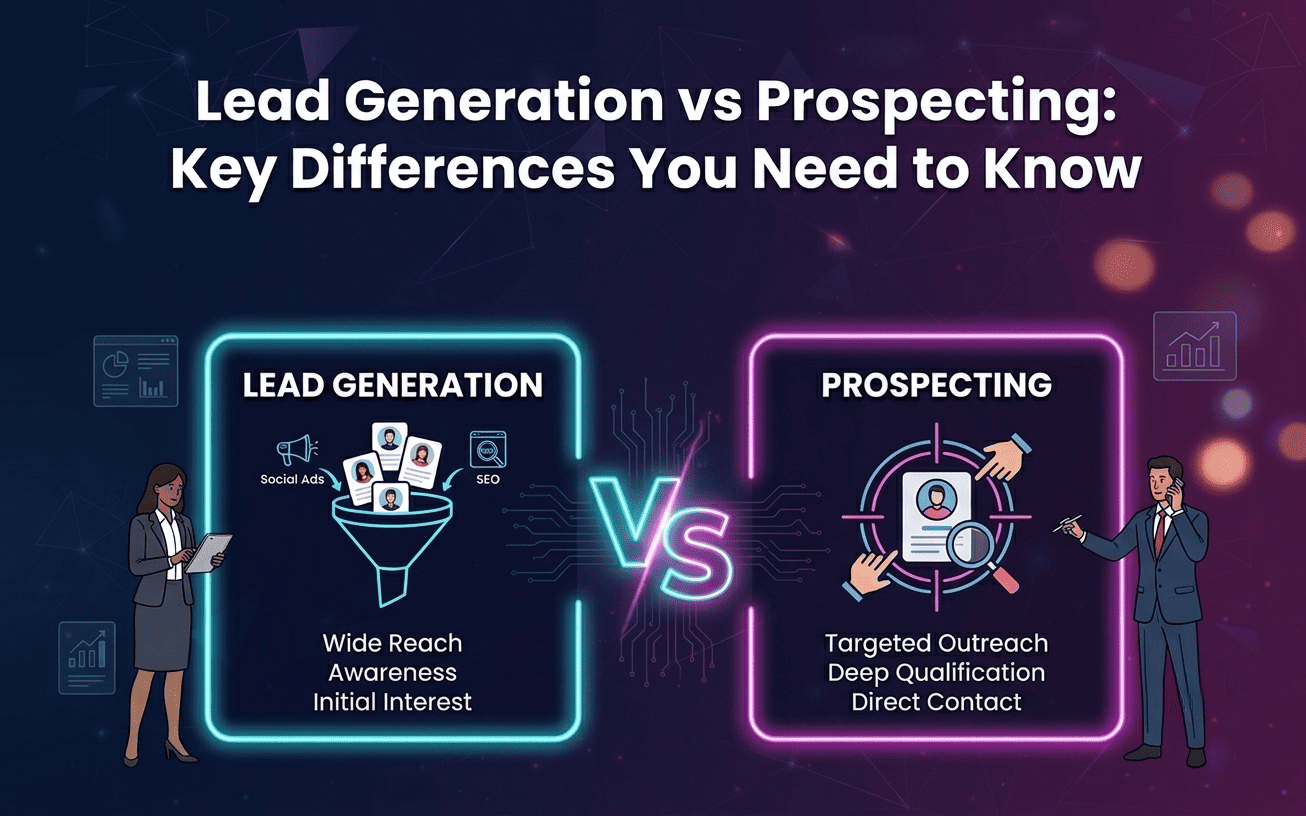
The truth is simple. Lead generation helps people find your business. Prospecting helps your business find the right people. Knowing when to use each strategy can help you build a stronger pipeline and close more deals.
In this guide, you'll learn:
- What lead generation and prospecting really mean
- The key differences between lead generation vs prospecting
- When each approach works best
- Why the best B2B teams use both together
- How AI helps turn anonymous website visitors into qualified leads
By the end of this guide, you'll understand how lead generation and prospecting complement each other and how to use both to build a stronger, more effective sales strategy.
What Is Lead Generation?
Lead generation is the process of attracting potential buyers and capturing their interest, usually through marketing. The goal is to fill the top of your funnel with interested people. They raise a hand, even slightly, by downloading a guide, joining a webinar, or filling out a form.
It works at scale and casts a wide net. You publish content, run ads, and optimize pages so the right audience finds you and self-selects. Most arrive as a marketing-qualified lead, or MQL, which means a lead your team judges ready to pass to sales.
Lead generation blends two motions. Inbound pulls people in through SEO, content, and social. Outbound pushes reach out through paid ads and sponsored placements. Either way, the buyer takes a step toward you first, which is what makes these leads warmer than a cold list.
By investing in quality content early, you create a long-term growth asset that continues attracting qualified leads and delivering business value long after it is published.
What Is Prospecting?
Prospecting is a sales-driven approach that focuses on finding and engaging potential buyers who align with your ideal customer profile. Instead of waiting for interest, your reps go and create it through direct, one-to-one outreach.
This is the work of your sales development reps (SDRs) and business development reps (BDRs). They build a target list, research each contact, and reach out by cold email, phone, or LinkedIn to spark a real conversation. The aim is immediate: qualify the person, gauge fit, and book a meeting.
Prospecting gives you control that lead generation cannot. You choose exactly who to contact and when. So you can fill a thin pipeline fast, or pour a whole quarter into a named set of dream accounts.
The trade-off is the level of effort involved, as every outreach is personalized to build meaningful connections with potential buyers.
If lead generation is the marathon, prospecting is the sprint. It focuses on helping sales teams quickly identify qualified prospects, engage them effectively, and move promising opportunities through the sales pipeline faster.
Lead Generation vs Prospecting: Key Differences
When you line up lead generation vs prospecting across the dimensions that matter, the contrast gets sharp. Use this table as your quick reference, then read the breakdowns below for the why behind each row.
Let’s understand in detail!
1. Passive Attraction vs Active Outreach
Lead generation earns attention quietly. You create something useful - a guide, a calculator, a webinar and let search and social carry it to buyers who are already looking. The buyer finds you, which makes the first conversation feel welcome rather than interruptive.
Prospecting flips that energy. Your rep decides who matters, then reaches out directly with a message built for that one person. Nobody asked for the email, so the bar is higher. The reward is a warm reply from exactly the buyer you wanted.
2. One-to-Many vs One-to-One
With lead generation, a single asset can reach thousands at once. One strong blog post or ad set keeps working around the clock, which is why marketing can influence a huge audience with a small team.
Prospecting trades that reach for intimacy. Each touch is researched and personal, so a rep speaks to one buyer at a time. Although prospecting reaches a smaller audience, its personalized approach builds stronger relationships and creates the trust needed to advance complex sales opportunities.
3. Marketing-Owned vs Sales-Owned
Lead generation lives with marketing. They run the campaigns, own the content calendar, and hand qualified leads across the line. Their success is measured by the volume of qualified interest they generate and the quality of prospects they bring into the sales pipeline.
Prospecting belongs to sales. SDRs and BDRs carry the quota of conversations, and their day is built around outreach, follow-up, and booked meetings. The clean handoff between these two teams is where the pipeline is won or lost.
4. The Long Game vs the Short Game
Lead generation compounds over time. The content you publish keeps ranking, the audience keeps growing, and your cost per lead drops as the engine matures. It rewards patience, not urgency.
Prospecting pays off now. A focused outbound push can book meetings this week, which is exactly what you want when the quarter is tight. The catch is that it stops the moment your reps stop, so it delivers bursts rather than a steady stream.
5. Quantity vs Quality (Warm vs Cold)
Lead generation leans toward volume. You attract a wide pool of interest, and not every contact will fit, so qualification has to happen downstream. The upside is a steady flow of warmer, self-selected leads.
Prospecting leans toward precision from the first move. Because your rep handpicks each target against your ICP, lead quality is high before a single message goes out. You speak to fewer people, but a far greater share of them belong in your pipeline.
6. Different Goals, Different KPIs
Lead generation measures the top of the funnel. Traffic, MQLs, conversion rate, and cost per lead tell you whether your engine is attracting the right people at a sane price.
Prospecting measures conversations and momentum. Reply rate, meetings booked, and conversion from contact to opportunity show whether your outreach is landing. Mix up these scorecards, and you will reward the wrong behaviour on both teams.
7. Control and Scalability
Lead generation scales beautifully but gives you less control. Content and automation can reach thousands at once, yet you depend on demand, so you cannot force the right buyer to show up today. It is a volume engine, not a targeting tool.
Prospecting flips both dials. You get near-total control over who you contact and when, which is its real superpower. The limit is capacity, because human reps can only send so many quality touches a day, at least until AI lifts that ceiling.
How Lead Generation Works: Core Strategies
On the lead generation vs prospecting map, every play here lives on the attraction side. Lead generation runs on value given upfront. You earn attention with something genuinely useful, then capture interest so your team can follow up.
These are the strategies that show up across nearly every high-performing program:
- Content marketing and SEO: Publish blogs, guides, and resources built around what your buyers search for, so the right traffic finds you organic search.
- Lead magnets and gated content: Offer an ebook, template, or report in exchange for an email, turning anonymous readers into known contacts.
- Paid advertising: Run targeted ads on search and social that put your offer in front of a precise audience and drive them to a landing page.
- Webinars and events: Host sessions that teach something real, then capture and follow up with everyone who registers.
- Landing pages and forms: Build focused pages with short forms that reduce friction and convert visitors into leads.
- Organic social: Show up consistently where your buyers spend time, share insight, and route interested followers back to your offers.
How Prospecting Works: Core Strategies
These tactics are the other half of lead generation vs prospecting, the active outreach side. Prospecting runs on direct, deliberate outreach. Your reps find the right people and start a real conversation, one message at a time.
These are the channels and tactics that consistently produce meetings:
- Cold email: Send personalised, research-backed emails that speak to a specific pain and ask for a low-friction next step.
- Cold calling: Pick up the phone to qualify fit, handle objections live, and book the meeting in a single conversation.
- LinkedIn and social selling: Connect with decision-makers, add value in their feed, and move warm threads into direct messages.
- Networking and referrals: Tap events, communities, and happy customers for warm introductions that skip the cold-start problem.
- Lead scoring and filtering: Prioritise targets by fit and behaviour so reps spend their hours on the contacts most likely to convert.
- CRM re-engagement: Revisit past leads with new timing, a fresh offer, or a relevant trigger to reopen a dormant conversation.
Also Read: Proven B2B Lead Generation Strategies
What Each Approach Does Best
Neither lead generation nor prospecting is better than the other. Each has its own strengths and works best in different situations.
Where Lead Generation Wins
- Builds a steady, long-term sales pipeline
- Increases brand awareness and trust
- Educates buyers before they talk to sales
- Brings in warmer, self-interested leads
- Lowers customer acquisition costs over time
- Scales easily through SEO, content, and marketing campaigns
- Best for businesses focused on long-term growth
Where Prospecting Wins
- Reaches your ideal buyers quickly
- Gives sales teams full control over who they contact
- Books meetings faster through direct outreach
- Works well for high-value and enterprise deals
- Helps fill the pipeline when you need results quickly
- Provides real-time feedback from potential customers
- Best for account-based selling and targeted outreach
When to Use Lead Generation vs Prospecting
The lead generation vs prospecting decision usually comes down to timing, resources, and the kind of deal you are chasing. Rather than choosing once and forever, match the motion to the moment.
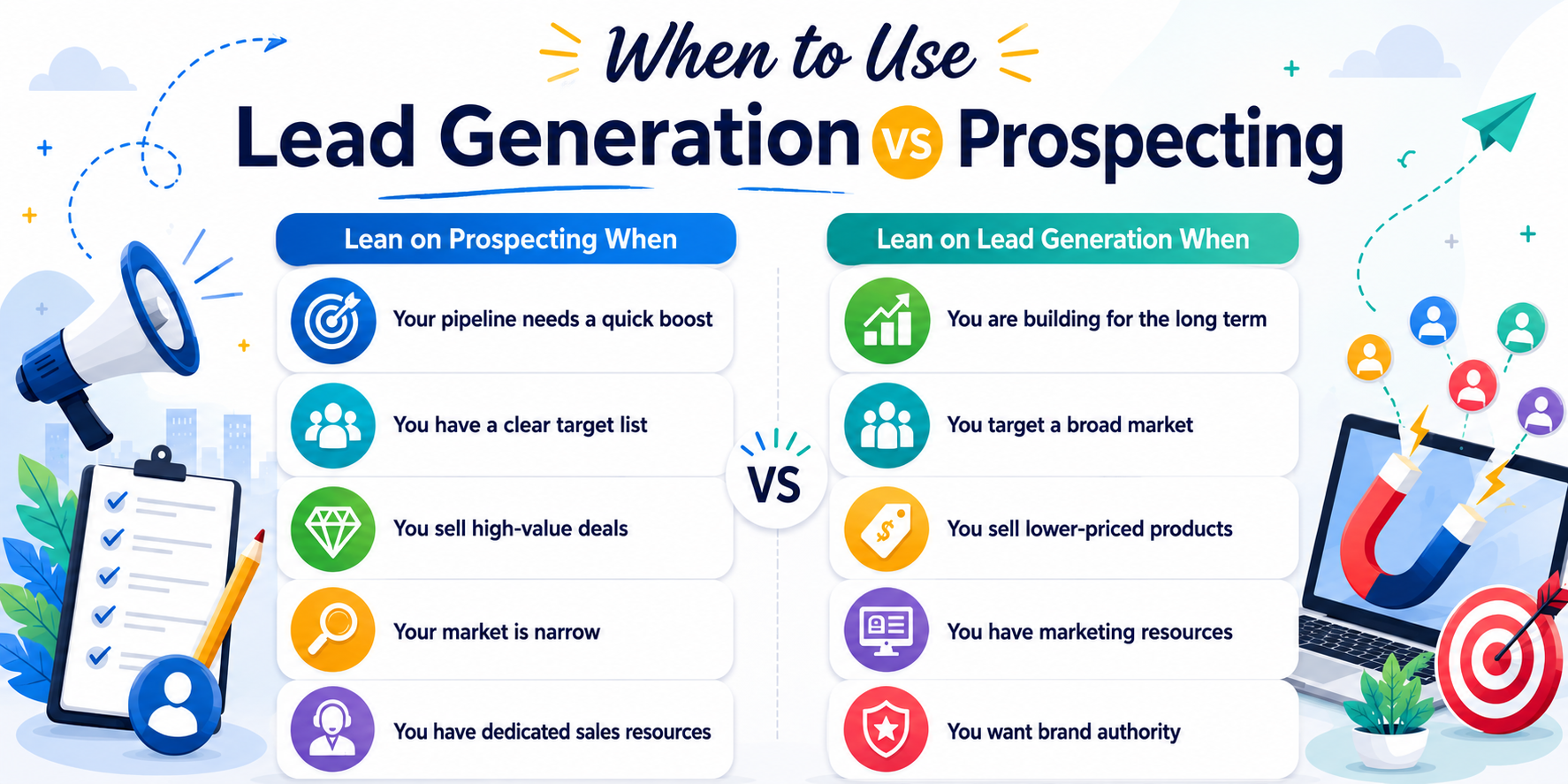
Lean on Prospecting When
- Your pipeline needs a quick boost: A quota crunch calls for direct outreach that can book meetings this week.
- You have a clear target list: When you already know the accounts that fit, prospecting focuses fire on exactly those buyers.
- You sell high-value deals: Big contracts reward the personal attention and trust-building that one-to-one outreach provides.
- Your market is narrow: In a tight niche, your buyers are easy to identify, so precise targeting beats a wide net.
- You have dedicated sales resources: With SDRs or BDRs focused on outreach, prospecting becomes repeatable and scalable.
Lean on Lead Generation When
- You are building for the long term: Content and SEO compound into a steady, predictable flow of leads over time.
- You target a broad market: When your product fits many segments, lead generation lets you reach all of them at once.
- You sell lower-priced products: For smaller deals, personalised outreach rarely pays off, so scalable attraction wins on cost.
- You have marketing resources: A content team and a healthy budget make lead generation a natural, high-ROI fit.
- You want brand authority: Educational content builds trust and positions you as the obvious choice, not just another vendor.
Why You Need Both: Aligning Marketing and Sales
Lead generation and prospecting work best when they work together. Lead generation attracts potential customers, while prospecting turns those interested leads into sales conversations.
For example, marketing may generate a lead through a blog, webinar, or ebook. Sales can then follow up with that lead through a personalized email or call. Since the buyer already knows your brand, they're more likely to respond.
To get the best results, marketing and sales should:
- Agree on what makes a qualified lead.
- Share feedback regularly to improve lead quality.
- Track common goals and performance metrics.
When both teams work together, you generate better leads, close more deals, and build a stronger sales pipeline.
Also Read: How To Identify Anonymous Website Visitors: Meet Kwin
How to Qualify a Lead: Quality Over Quantity
A large number of leads doesn't guarantee more sales. The goal is to identify the leads that are most likely to become customers.
Before passing a lead to sales, check whether it meets these criteria:
- ICP fit: Matches your ideal customer profile.
- Decision-maker: Can influence or approve the purchase.
- Business need: Has a problem your solution solves.
- Purchase intent: Shows buying signals, such as pricing page visits or repeat website visits.
- Budget: Has the potential to afford your solution.
- Timeline: Is actively looking for a solution.
Prioritizing leads based on ICP Fit and Purchase Intent helps your sales team focus on the opportunities most likely to convert.
5 Common Mistakes to Avoid
Even strong teams trip over the same few errors when they run lead generation and prospecting. Spot these early, and you save months of wasted effort.
1. Treating Lead Generation and Prospecting as the Same
Lead generation vs prospecting serve different purposes. Mixing them up leads to poor planning, unclear responsibilities, and weaker results.
2. Prioritizing Quantity Over Quality
Generating more leads is not enough. Focusing on qualified leads that match your ideal customer profile produces better conversions and saves your sales team valuable time.
3. Relying on Unverified Contact Lists
Buying outdated or unverified lead lists often results in low response rates, poor-quality prospects, and can even damage your email reputation.
4. Ignoring Lead Nurturing
Not every lead is ready to buy immediately. Regular follow-ups and helpful content keep potential customers engaged until they are ready to make a decision.
5. Poor Marketing and Sales Alignment
When marketing and sales do not agree on what makes a qualified lead, valuable opportunities are often delayed, overlooked, or lost altogether.
How AI Unifies Lead Generation and Prospecting
For years, the gap between attracting a buyer and reaching them was filled by hours of manual work. AI now collapses that gap, which is why the lead generation vs prospecting divide is starting to disappear. An AI Business Developer identifies the buyer, qualifies them, and starts the conversation, all on autopilot.
It helps to see how identification actually works, because the depth is what makes it reliable. The process is sophisticated, but it is handled for you, step-by-step:
Step 1: Pixel install: You add a lightweight pixel to your site header or through Google Tag Manager. It takes about five minutes and no code.
Step 2: Signal capture: As visitors browse, the system captures signals like IP, device, browser, referral source, session, page views, and on-site behaviour.
Step 3: Enrichment: Those signals are matched against proprietary and third-party data sources to build a fuller picture of who is visiting.
Step 4: Company identification: Using IP intelligence, ASN mapping, and firmographics, the system resolves which company the visit belongs to.
Step 5: Person identification: Identity resolution across hundreds of data points, supported by identity graphs and confidence scoring, names the actual person behind the visit, not just the company.
Step 6: Intent and qualification: The visitor's behaviour and fit are scored into an ICP fit score and a Purchase Intent Score, so only the right buyers move forward.
Once a buyer is identified and scored, the two motions merge. The same engine that warmed them up can reach out immediately. That crushes your speed-to-lead, meaning how fast you follow up after someone shows interest. The buyer gets a relevant message while they are still thinking about you, not days later when the moment has passed.
Now that you have seen how AI ties identification to action, let's compare the tools that put it to work.
Best Tools to Power Lead Generation and Prospecting
The market is full of tools for lead generation vs prospecting, but they serve very different masters. Some only generate leads, some only find contacts, and some only name the company.
The table below compares the main categories, with Kwin first because it is the only one that runs the full motion end-to-end.
Looking at the comparison above, one thing stands out: most tools only do one job.
Some tell you which company visited your website, but not the actual person. Others give you contact lists, but they can't tell you who's interested in your business today. CRMs only track people who fill out a form, meaning most of your website visitors remain anonymous.
Kwin solves all of these problems in one platform. It identifies both the company and the person behind the visit, scores their buying intent, and automatically reaches out to qualified leads. Instead of giving your team more data to sort through, Kwin helps turn anonymous website visitors into real sales opportunities.
Meet Kwin: Your AI Business Developer That Does Both
Kwin is an AI Business Developer, not a dashboard you log into, and she works your website traffic like a tireless member of the team.
Here is what Kwin actually does, end to end:
- Identifies people, not just companies: Kwin reveals names, work emails, phone numbers, LinkedIn profiles, plus company, revenue, industry, and location data, at both the person and company level.
- Covers 60 to 70% of visitors across 175+ countries: You see a real share of your traffic, globally, not a US-only slice.
- Scores every visitor: Kwin sets an ICP fit score and a real-time Purchase Intent Score from live browsing behaviour.
- Acts only on the right leads: You set a minimum ICP and Purchase Intent threshold. Kwin acts only once a visitor crosses it, so your team is never flooded.
- Nurtures from your own domain: High-fit visitors receive a personalized email sequence sent from your domain, so it feels like your brand, because it is.
- Hands off on a positive reply: When a lead replies, Kwin forwards the full thread plus a short summary to your inbox. It then routes to Slack, your CRM, and your existing tools.
- Filters the noise: Country-level and page-level filters let you focus on the traffic you want and screen out public sector and government visits.
- Starts free: The free forever Lead Watcher plan includes 100 leads/month with no credit card, and the Win+ plan adds a trial.
- Stay compliant: Kwin works from publicly available business data and is SOC 2 Type II, GDPR, CCPA, ISO 9001:2015, and ISO 27001:2022 compliant.
Today, Kwin automates the predefined identify, qualify, nurture, and handoff workflow, and custom workflows are in development.
Try Kwin For Free and put your anonymous traffic to work; no credit card required.
Conclusion
Lead generation and prospecting are not enemies; they are two halves of a healthy pipeline.
Lead generation attracts buyers at scale and plays the long game. Prospecting reaches chosen buyers directly and plays the short game. Run them together, with a clean handoff, and your funnel both fills and converts.
But the biggest opportunity in the lead generation vs prospecting debate is the one most teams miss. It is the buyers already on your site who never fill out a form. Identify them, score them, and act before the moment fades, and you turn quiet traffic into booked meetings.
We hope this guide helped you understand exactly how lead generation vs prospecting differ, when to use each, and how to bridge the two. Now it is your turn to put it into motion.
Want a faster path? Book a free demo to see how Kwin turns your anonymous traffic into a pipeline that never runs dry.