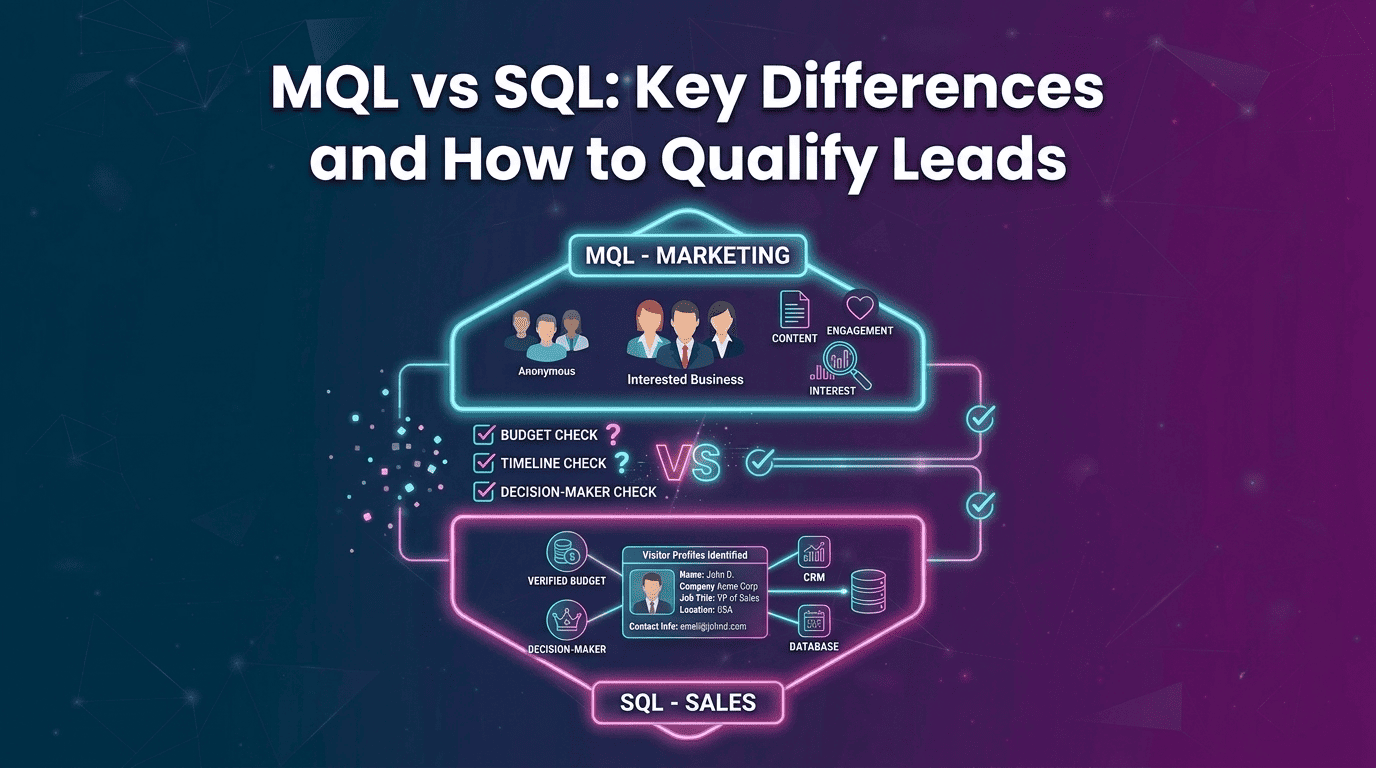

TL;DR: MQLs show interest, while SQLs show stronger buying intent, fit, authority, and timing. This guide explains the key MQL vs SQL differences, conversion benchmarks, lead scoring, qualification criteria, and handoff best practices. It also covers how to identify and qualify high-intent website visitors who never fill out a form, so your sales team can focus on prospects most likely to convert.
Your marketing team reports 400 new leads this month. Sales says only nine were actually worth calling. Both teams may be right.
The problem is not always lead quality. It is how you define and qualify a lead before sales gets involved.
An MQL has shown interest. An SQL has shown buying intent, fit, and a reason to talk now. Knowing where that line sits can save sales time and protect your pipeline.
But there is one bigger problem: many serious buyers never fill out a form.
They visit your pricing page, compare solutions, read case studies, and leave without giving you their details. If your qualification process starts only after a form fill, you may be missing some of your best prospects.
That is why modern MQL vs SQL qualification needs more than form fills and lead scores. You need to capture buyer signals, measure fit and intent, and act when a prospect is actually ready.
In this guide, you will learn:
- What MQL and SQL really mean
- The key differences between them
- Where each fits in the sales funnel
- How to qualify visitors who never fill out a form
- Which tools can help identify and qualify high-intent visitors
By the end, you will have a clearer way to separate curious visitors from genuine buyers and move qualified prospects to sales at the right time.
What Is a Marketing Qualified Lead (MQL)?
A marketing qualified lead is a contact who has engaged with your marketing and matches your ideal customer profile. Your ideal customer profile, or ICP, describes the accounts you sell to best. They are interested, but they are not yet buying.
Think of an MQL as a raised hand rather than an open wallet. Somebody downloaded your guide, joined a webinar, or came back to your site three times in a fortnight. That behaviour signals curiosity, not commitment.
Marketing owns this stage. The job here is education, trust, and patience, because pushing a researcher into a sales call almost always ends the relationship early.
Signals That Create an MQL
Most references agree on a short list of behaviours that reliably mark early interest. These are the ones worth scoring:
- Content downloads: Ebooks, whitepapers, templates, and research reports pulled from your top-of-funnel library.
- Webinar and event attendance: Registering and actually showing up for an educational session on a problem you solve.
- Newsletter subscription: Opting into recurring communication, which shows the reader wants an ongoing relationship.
- Repeat website visits: Returning to product or solution pages more than once inside a short window.
- Email engagement: Consistent opens and clicks across a nurture sequence rather than a single accidental click.
What Is a Sales Qualified Lead (SQL)?
A sales qualified lead has crossed from research into evaluation. They are comparing vendors, checking pricing, and building an internal case, which makes a direct conversation genuinely useful to them.
The distinction is not enthusiasm. It is a capability. An SQL has a real problem, a workable budget, and someone in the room who can sign.
Sales owns this stage, and that ownership matters. In most mid-market teams, a rep or SDR validates the lead before it becomes a formal opportunity, which keeps the pipeline honest.
Sales Qualified Lead Criteria Most Teams Agree On
Across every serious reference on MQL vs SQL, the same qualifying criteria appear again and again. Use these five as your baseline:
- Demonstrated buying intent: A demo request, a pricing enquiry, or a direct question about implementation.
- ICP fit: Industry, company size, revenue band, and geography line up with the customers you already win.
- Decision authority: The contact either signs or sits on the committee that does.
- Confirmed budget: Money exists, or a budget request is already moving through approval.
- Active timeline: They are working toward a decision date rather than researching for a future quarter.
MQL vs SQL: The Key Differences
The table below shows the full MQL vs SQL split. It covers the nine attributes that genuinely change how you work a lead.
Where MQLs and SQLs Sit in the Sales Funnel
Mapping the MQL vs SQL split onto funnel stages tells your team what to send, when to send it, and who owns the next move.
Also Read: Top 10 Website Visitor Tracking Tools: How to Identify Who Visits Your Site
Metrics to Track Alongside Your Conversion Rate
Five metrics tell you almost everything about the health of your MQL vs SQL process. Track them together, because any one in isolation misleads.
How to Qualify Leads You Never Captured
This is the mechanism, step by step. It is genuinely sophisticated work under the surface, and it is worth understanding properly before you evaluate any vendor.
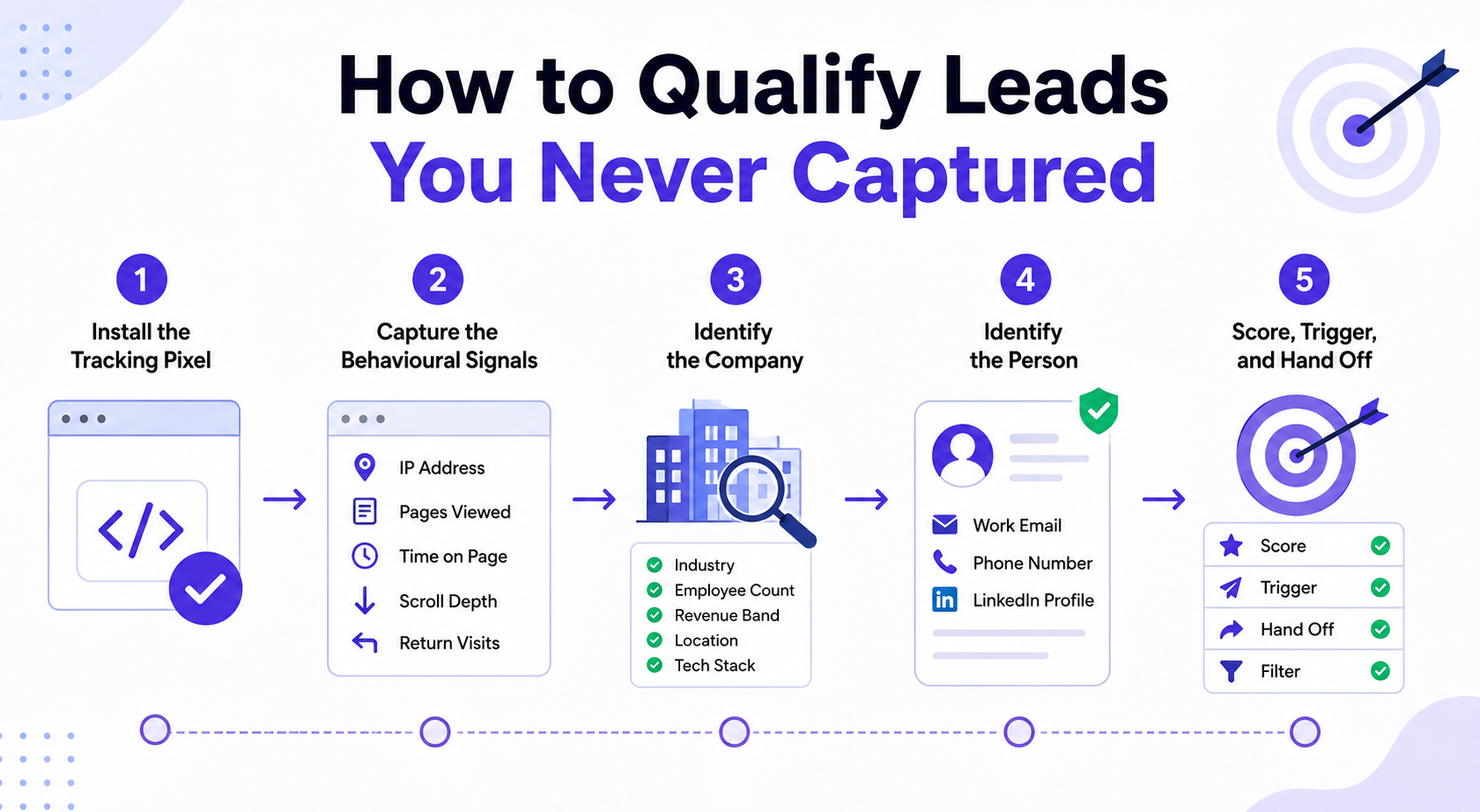
Step 1: Install the Tracking Pixel
You start by placing a small script in your website header or through Google Tag Manager. It takes about five minutes and needs no developer time.
From that moment, the pixel begins observing sessions on your site. Nothing is inferred yet, because the system is only collecting raw signals at this stage.
Install it site-wide rather than on selected pages. Partial coverage produces partial journeys, and partial journeys score badly.
Step 2: Capture the Behavioural Signals
Next, the system records what actually happened during the session. That includes IP address, device and browser fingerprint, referral source, pages viewed, view sequence, time on page, scroll depth, and return visits.
Each signal is weak on its own. Combined, they form a behavioural fingerprint distinctive enough to work with.
Sequence carries real meaning here. Someone who moves from a blog post to a comparison page to pricing is behaving very differently from someone who bounced off your careers page.
Step 3: Identify the Company
Now the resolution work begins. The system maps the visitor's IP address against IP intelligence databases. It then performs ASN mapping, which traces the network block back to the organisation that owns it.
Corporate networks resolve cleanly because companies register their address ranges. Residential and mobile connections are harder, which is why remote workers push match rates down across the whole category.
Once the company is identified, firmographic enrichment is layered on. That means industry, employee count, revenue band, headquarters location, and technology stack.
Step 4: Identify the Person
This is the hardest step, and it is where most tools stop. Person-level identification uses identity resolution, which matches behavioural and technical signals against identity graphs built from publicly available business data.
An identity graph links related data points into a single profile across hundreds of attributes. The system compares your visitor's fingerprint against those profiles and returns a confidence score for each possible match.
Only matches above the confidence threshold are surfaced. That threshold is why honest vendors publish identification rates in a range rather than claiming they catch everyone.
Kwin resolves 60% to 70% of visitors at both person and company level across 175+ countries. She returns names, work emails, phone numbers, LinkedIn profiles, plus company, revenue, industry, and location data.
Step 5: Score, Trigger, and Hand Off
Once a visitor is identified, Kwin scores them on ICP Fit and Purchase Intent. You set the minimum thresholds, and Kwin acts only when both are met.
- Score: Measures fit and buying intent.
- Trigger: Starts a personalized email sequence from your domain.
- Hand off: Sends positive replies to your inbox, Slack, CRM, and other tools.
- Filter: Control leads by country, page, data type, and exclusions such as government traffic.
Also Read: Factors AI Alternatives: Top 10 Tools for Person-Level Visitor Identification
Common MQL vs SQL Mistakes That Cost Pipeline
These seven mistakes show up in almost every audit. Each one has a fix you can apply this week.
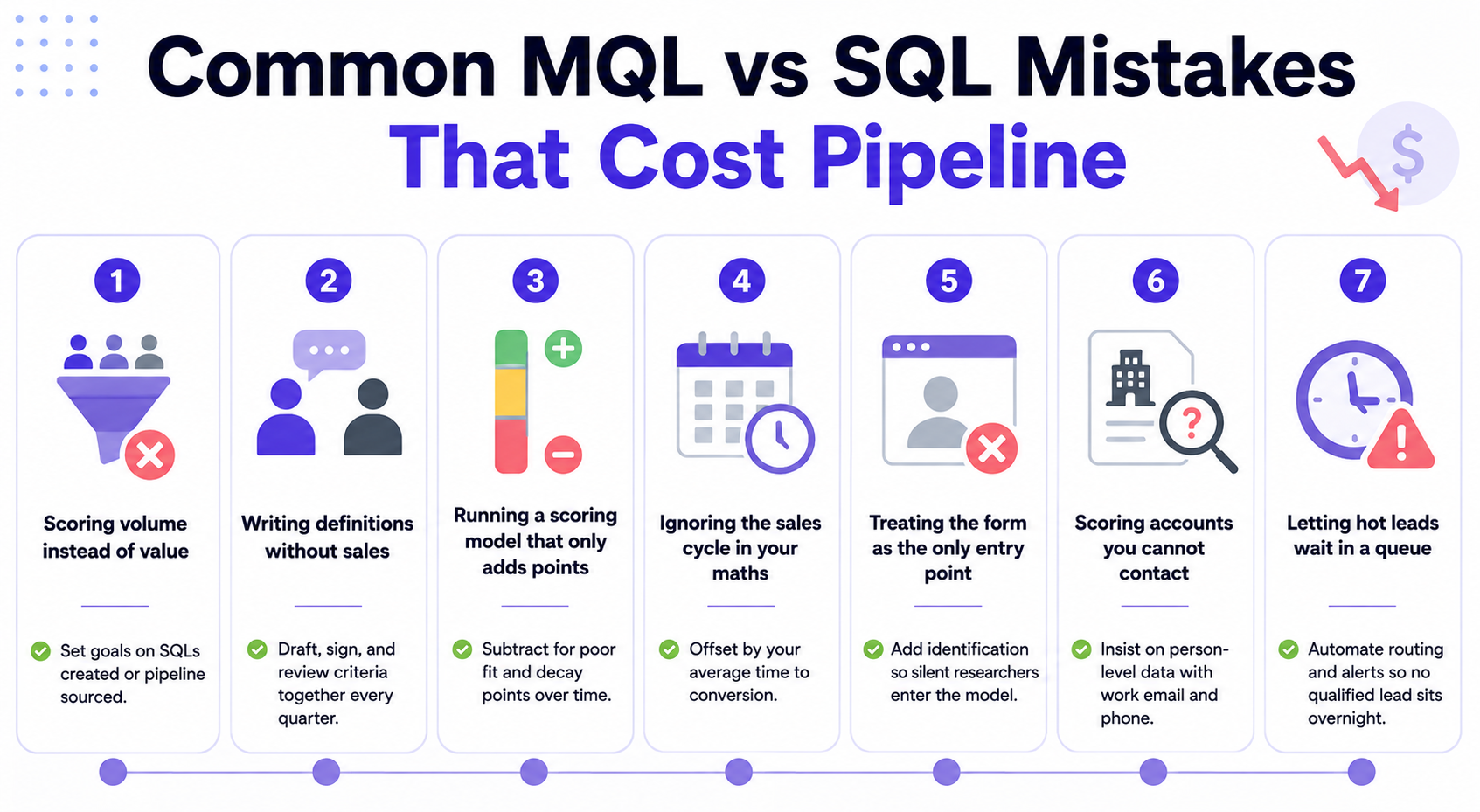
- Scoring volume instead of value: Chasing an MQL target rewards cheap form fills from poor-fit traffic. Set the goal on SQLs created or pipeline sourced, and watch campaign selection improve immediately.
- Writing definitions without sales: A marketing-only definition guarantees rejection later. Draft the criteria together, sign it together, and review it together every quarter.
- Running a scoring model that only adds points: Without negative scoring and decay, everyone eventually looks qualified. Subtract for poor fit and reduce intent points during silence.
- Ignoring the sales cycle in your maths: Comparing same-month MQLs and SQLs understates your rate badly. Offset the comparison window by your average time to conversion.
- Treating the form as the only entry point: If a visitor has to self-identify before scoring starts, your best buyers stay invisible. Add an identification layer so silent researchers enter the model too.
- Scoring accounts you cannot contact: A company name with no named person leaves your rep doing manual detective work. Insist on person-level data with work email and phone number attached.
- Letting hot leads wait in a queue: Intent decays within hours, not days. Automate routing and alerting so no qualified lead sits untouched overnight.
Lead Qualification and Identification Tools Compared
If you want to qualify buyers who never fill a form, you need identification alongside scoring. Here is how seven options compare.
Why Kwin Stands Out
Kwin by Vison AI works as an AI Business Developer that identifies high-intent website visitors, qualifies them, and helps turn them into sales opportunities. Instead of stopping at company identification, Kwin identifies both people and companies across 175+ countries.
Kwin combines visitor data with AI scoring to find prospects that match your ICP and show buying intent. When a visitor meets your criteria, Kwin can personalize outreach, handle positive replies, and send qualified leads directly to your CRM or Slack.
With Kwin Signals, you can also track buying activity beyond your website. The platform is backed by SOC 2 Type II, GDPR, CCPA, ISO 27001:2022, and ISO 9001:2015 compliance.
Why Choose Kwin?
- Person and company identification: Identify visitors across 175+ countries with names, work emails, LinkedIn profiles, job titles, industry, and revenue.
- Behavior analysis: See what identified visitors do on your website through the User Activity tab.
- AI scoring: Combine ICP Fit and Purchase Intent to prioritize high-value prospects.
- Automated outreach: Send personalized emails and handle positive replies automatically.
- Kwin Signals: Track buying signals from sources beyond your website.
- Smart filters: Filter visitors by country, page, industry, company size, and lead type.
- Instant handoff: Send qualified leads directly to Slack and your CRM.
- Strong compliance: SOC 2 Type II, GDPR, CCPA, ISO 27001:2022, and ISO 9001:2015.
- Free to start: Get 100 identified leads per month with no credit card required.
- Flexible pricing: Win+ starts at $75/month for up to 300 leads, with a 7-day free trial. Pay-As-You-Go costs $0.50 per identified lead.
Ready to Turn Anonymous Visitors Into Sales Opportunities?
Book a Free Demo and turn anonymous traffic into booked meetings. 100 leads every month, free forever, no credit card required.
Conclusion
MQLs show interest. SQLs show they are ready for a sales conversation. The key is knowing when a lead has moved from one stage to the next.
A strong MQL vs SQL process uses fit, intent, and timing to qualify leads, while clear scoring and fast handoffs help sales act at the right moment.
But forms should not be the starting point. Many serious buyers research your website without filling one out. Identifying these visitors gives your team a chance to engage before they choose a competitor.
That is where Kwin helps. It identifies visitors at the person and company level, scores them based on fit and intent, and automates outreach and handoffs.
Hire Kwin For Free and see how it can turn anonymous traffic into qualified opportunities.