
TL;DR:
Lead Forensics identifies the companies visiting your website, but the best alternatives go much further. They reveal the actual person behind the visit, measure buying intent, and even automate outreach. Our top pick is Kwin by Vison AI, which identifies both companies and people, qualifies visitors, and helps turn anonymous website traffic into booked meetings. It identifies 60 to 70% of visitors across 175+ countries and offers a free forever plan with 100 leads per month and no credit card required.
Your website is your hardest-working salesperson, but most buyers leave without saying a word. They browse your pages, compare your solution, and leave without filling out a form. You never know who they are.
Website visitor identification tools like Lead Forensics helped solve part of that problem by showing which companies visited your website. For years, that was enough.
Today, modern buyers now expect more than a company name. They want to know who visited, how interested they are, and how to reach them before they move on.
Which is why so many revenue teams shop for lead forensics alternatives. They want the person, the intent, and the follow-up, ideally handled by an AI Business Developer rather than another dashboard to babysit.
The biggest problem is simple. Company-level tools tell you which company visited your website, but not who from that company visited. Without knowing the actual person, your sales team does not know who to contact.
The best Lead Forensics alternatives solve this by showing who visited your website, how interested they are, and helping you reach them before they leave.
Now the question is: how do you find the best Lead Forensics alternatives? We've got you covered!
In this guide, you will learn:
- Why B2B teams are replacing Lead Forensics
- How website visitor identification actually works
- What to look for when comparing tools
- The 15 best Lead Forensics alternatives, compared
- How to choose the right platform for your team
By the end, you will know which Lead Forensics alternatives fit your budget, your region, and your goals. You will also know how to turn anonymous traffic into booked meetings.
What Lead Forensics Does Well (and Where It Falls Short)
Lead Forensics is a reliable tool for identifying the companies that visit your website. It provides useful company details like industry, size, and location, and integrates with popular CRMs. If you only want to know which companies are visiting your site, it does the job well.
However, it stops there. It does not identify the actual person behind the visit, measure buying intent, or automatically follow up with potential customers. If your goal is to turn more website visitors into booked meetings, you will likely need a more advanced alternative.
How Website Visitor Identification Works
Website visitor identification is simpler than it sounds. Here’s how it identifies who visits your website:
1. Install a Tracking Pixel
The process starts by adding a small tracking pixel to your website. It collects basic visitor information such as the IP address, device, browser, pages viewed, referral source, and time spent on your website.
2. Match the Visitor Data
The platform compares this information with trusted business databases and other data sources. This helps turn anonymous website visits into useful business information.
3. Identify the Company
Next, the platform identifies the company behind the visit. It also provides useful details like the company's industry, size, revenue, and location, helping you understand who is interested in your business.
4. Identify the Person
The best tools go a step further by identifying the actual person who visited your website. Depending on the platform, you may see their name, job title, work email, phone number, and LinkedIn profile, making it much easier for your sales team to reach the right decision-maker.
5. Measure Buying Intent
Finally, the platform looks at the visitor's behavior, such as which pages they viewed, how long they stayed, and whether they returned to your website. It then assigns a buying intent score, helping your sales team focus on visitors who are most likely to become customers.
Why Are B2B Teams Replacing Lead Forensics? 7 Reasons
Lead Forensics built its name on reverse IP lookup, which matches a visitor's IP address to a company in a large business database. That approach still has fans, yet the cracks show as buying behaviour changes. Below are the reasons revenue teams give most often when they start comparing lead forensics alternatives.
1. IP-Only Matching Misses the Modern Buyer
Reverse IP works best when people sit in one office on one corporate network. Remote work, VPNs, and mobile traffic break that assumption every day. When the IP does not resolve cleanly, the visit stays anonymous or maps to the wrong company. G2 reviewers of Lead Forensics regularly flag accuracy gaps, and those misses cost you real conversations.
2. Company Names, Not the People Who Actually Visited
Lead Forensics tells you a company stopped by, but not which decision-maker was reading. Your reps still have to guess who to contact and hunt for a work email. Knowing exactly who is actually visiting your website at the person level removes that manual dig. That is the single sharpest reason teams move to person-level tools.
3. Opaque Quote-Only Pricing and Annual Lock-In
Lead Forensics does not publish prices, and quotes scale with your traffic volume. Buyers also report annual contracts as the default, which locks smaller teams in from day one. Many users on G2 and TrustRadius call the platform expensive for what it delivers. Predictable, flexible pricing is a common wish among people evaluating alternatives.
4. Identification Without Activation or Outreach
Seeing a company is only step one, and Lead Forensics stops close to there. It offers no built-in email sequences and no autonomous follow-up. Your team still exports data and works every lead by hand, which slows speed-to-lead. Intent cools fast, so a tool that acts on a signal beats one that only reports it.
5. Delayed Reports Instead of Real-Time Signals
Buyers research in short, high-intent bursts, then move on. When insights arrive as a dashboard you have to log in and check, the window closes. Real-time alerts to Slack or your CRM keep your team fast while attention is still warm. Slow reporting is a recurring complaint that pushes teams toward newer platforms.
6. Thin Intent Data and No Buying-Signal Scoring
Firmographic data alone does not tell you who is ready to buy. Lead Forensics offers limited intent depth and no native fit-plus-intent scoring. Without that, every identified company looks the same, and reps waste time on tyre-kickers. Scoring by fit and behaviour is now table stakes for serious pipeline work.
7. Coverage Gaps Outside the US and Western Europe
Legacy IP databases skew toward US and Western European companies. If your traffic is global, coverage thins out fast in other regions. Teams selling worldwide need a tool that identifies visitors far beyond a single market. Broad, multi-region coverage is a deciding factor for many buyers.
Also Read: How To Identify Anonymous Website Visitors: Meet Kwin, Your AI Business Developer
15 Best Lead Forensics Alternatives at a Glance
Here is the full shortlist in one view. Scan the table, then read the deep dives below for the detail behind each pick.
Let’s explore each company in detail.
1. Kwin by Vison AI: Best Overall Person-Level AI Business Developer
Kwin is not another visitor tracking dashboard. She is an AI Business Developer, a digital teammate who works your website traffic while you sleep. That single difference is why she tops this list of lead forensics alternatives.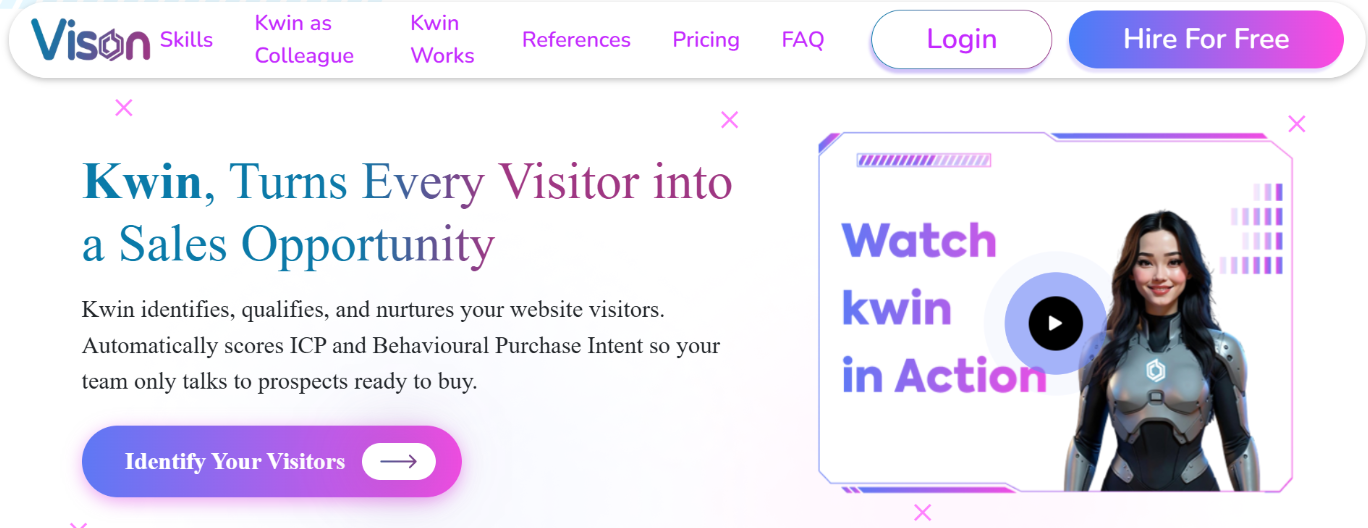
Most tools on this page stop at identification. They hand you a company name, or if you are lucky, a person, then leave the outreach to you. Kwin closes that loop instead. She identifies the visitor, scores them, emails them, and hands the hot ones to your team.
Her identification runs deep. Kwin reveals both the company and the person behind a visit, at 60 to 70% of your traffic, across 175+ countries. You get names, work emails, phone numbers, and LinkedIn profiles, not just a logo.
Then she qualifies each one. Kwin scores every visitor by ICP fit and Purchase Intent, and acts only once a lead crosses the threshold you set. That means no noise and no chasing tyre-kickers, just the buyers who matter.
Finally, she acts on it. Kwin sends a personalized email sequence from your own domain, forwards positive replies to your inbox, and pushes sales-ready leads to Slack and your CRM. That last step is exactly what legacy tools leave undone.
Key Features
- Person and company identification: Reveals names, work emails, phone numbers, LinkedIn profiles, plus company revenue, industry, and location, at 60 to 70% of visitors across 175+ countries.
- Fit and intent scoring: Calculates an ICP fit score, how well a visitor matches your ideal customer, and a Purchase Intent score, how ready they are to buy.
- Threshold-based action: You set a minimum ICP fit and Purchase Intent score, and Kwin acts only once a visitor crosses it.
- Autonomous nurture and handoff: Sends a personalized email sequence from your own domain, then forwards positive replies with a short summary and loops your team in through Slack and CRM.
Pros
- Both levels, globally: Company and person-level identification well beyond a single region.
- Truly hands-free: Runs the identify, qualify, nurture, and handoff loop without manual work.
- Free forever entry: Real value before you ever pay, with no credit card needed.
Cons
- Newer challenger: A younger platform than legacy IP vendors, though it is built for exactly this job.
- Predefined workflow today: Kwin automates the identify, qualify, nurture, and handoff flow now, with custom workflows in development.
Pricing: Free forever with the Lead Watcher plan: 100 leads per month, no credit card. The paid Win+ plan adds more volume and automation and includes a 7-day free trial.
Best for: Growth-focused B2B teams that want person-level identification and automated outreach in one place. Ideal if your goal is to book meetings, not another report to read.
Hire Kwin For Free and start identifying your visitors today, no credit card required.
2. Leadfeeder (Dealfront)
Leadfeeder, now part of Dealfront, ties into your analytics to show which companies visit and what they view. It is a familiar, GDPR-native option for European teams that want company-level visibility. It reports well, yet it rarely names the person behind the visit. For a deeper feature-by-feature view, see our Kwin vs Leadfeeder comparison.
Key Features
- Company identification: Matches visits to companies and shows page-level activity.
- Behaviour views: Tracks which pages and content each company engages with.
- CRM and Slack alerts: Pushes leads and notifications into your sales stack.
- Free entry tier: Offers a limited free plan to start.
Pros
- Easy setup: Fast to connect and start seeing companies.
- Clean interface: Reviewers on G2 praise its usability.
- Solid integrations: Works with common CRMs and Slack.
Cons
- Company-level focus: Rarely identifies the individual visitor.
- No native outreach: You still work every lead by hand.
- Data gaps abroad: Coverage thins outside core markets, per user reviews on G2.
Pricing: Free plan (up to 100 companies per month, 7-day data retention). The paid Web Visitors plan starts around $99/month billed annually and scales by companies identified, with a 14-day free trial.
Best for: Marketing teams that want simple, company-level reporting tied to analytics. A fair fit if person-level data is not your priority.
3. ZoomInfo
ZoomInfo is a heavyweight sales intelligence platform with a vast contact database and a WebSights module for visitor identification. Large enterprise teams lean on it for outbound data and intent. It is powerful, but it is priced and built for scale, which overwhelms smaller teams. Our ZoomInfo alternatives guide digs deeper.
Key Features
- Large contact database: Extensive company and contact records with firmographics.
- WebSights module: Identifies companies visiting your site.
- Intent signals: Surfaces accounts showing buying activity.
- Broad integrations: Connects to major CRMs and marketing tools.
Pros
- Deep data: One of the largest B2B datasets available.
- Strong for outbound: Rich contact details for cold outreach.
- Enterprise features: Advanced segmentation and workflows.
Cons
- Data can go stale: Reviewers on G2 note accuracy and outdated-record complaints.
- Costly and complex: Heavy for small and mid-sized teams.
- Company-first website ID: WebSights learns company-level, not person-level.
Pricing: No public pricing. Enterprise plans typically start around $10,000/year and can exceed $20,000/year, depending on seats and modules.
Best for: Large outbound teams with the budget and headcount to run a full intelligence suite. Overkill for lean teams focused on inbound.
4. 6sense
6sense is an account-based platform built around predictive intent and orchestration. It excels at telling large teams which accounts are in-market. That power comes with enterprise pricing and a steep learning curve. Compare options in our 6sense alternatives guide.
Key Features
- Predictive analytics: Models that predict which accounts are likely in-market.
- Intent data at scale: Aggregates large volumes of buying signals.
- ABM orchestration: Coordinates campaigns across channels.
- Account scoring: Ranks accounts by predicted readiness.
Pros
- Deep intent: Strong predictive signal for enterprise ABM.
- Sales and marketing alignment: Shared account view across teams.
- Scales widely: Built for large go-to-market motions.
Cons
- Enterprise pricing: Well beyond most SMB budgets.
- Complex to run: Requires dedicated resources to master.
- Account-first: Focuses on accounts, not individual website visitors.
Pricing: Custom quote, enterprise pricing. Full ABM plans commonly start around $10,000/year and scale into six figures.
Best for: Large organisations running mature ABM with a dedicated ops team. Not designed for small teams chasing quick pipelines.
5. Warmly
Warmly focuses on real-time engagement, pairing website deanonymization with live chat and intent signals. It suits inbound teams that want to catch buyers at the moment. It reveals companies and some individuals, and it bundles several data sources. Coverage and cost climb as you scale.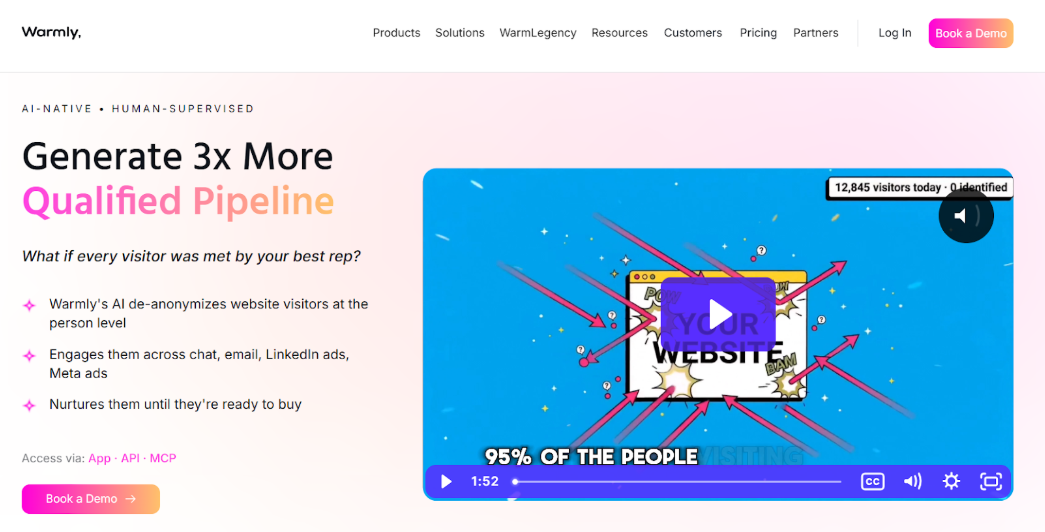
Key Features
- Website deanonymization: Reveals companies and some person-level visitors.
- Live chat orchestration: Engages hot visitors in real time.
- Bundled intent data: Combines several third-party data sources.
- CRM and Slack alerts: Routes signals to your team fast.
Pros
- Real-time focus: Good for engaging warm inbound traffic.
- Bundled data: Includes tools you might otherwise buy separately.
- Modern integrations: Connects with common revenue tools.
Cons
- Uneven person-level match: Individual identification lags company-level coverage.
- Cost grows fast: Pricing rises as traffic and needs scale.
- Setup effort: Getting full value takes configuration.
Pricing: Free plan available. Paid plans start around $499/month (Micro), scaling to five-figure annual contracts.
Best for: Inbound-led teams that want to chat with high-intent visitors live. A fair option when real-time engagement is the main goal.
6. RB2B
RB2B made its name by revealing person-level visitors and pushing them to Slack. It is a strong pick when your traffic is mostly US-based. Coverage narrows sharply outside the US, and it lacks built-in nurturing. Reps still need a separate tool to follow up.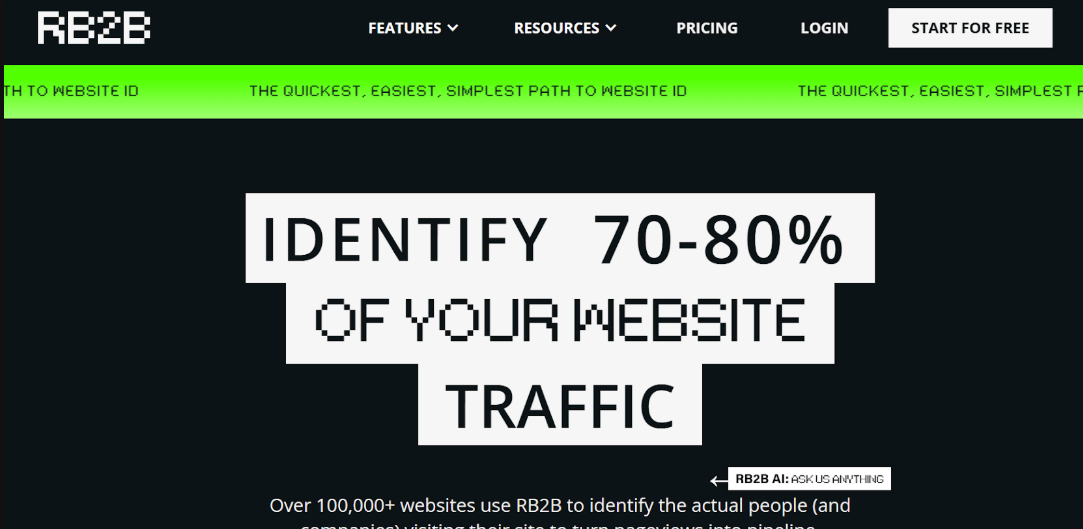
Key Features
- Person-level identification: Surfaces LinkedIn profiles and job titles for US visitors.
- Real-time Slack alerts: Notifies your team as visitors arrive.
- Integrations: Connects with HubSpot, Salesforce, and more.
- Engagement detail: Shows page views and return visits.
Pros
- Person-level data: Names real individuals, not just companies.
- Fast alerts: Instant Slack notifications for hot leads.
- Useful analytics: Clear engagement insights.
Cons
- US-heavy coverage: Person-level data mainly works for US traffic.
- No native nurture: You still need a separate outreach tool.
- Credit costs climb: Higher volume raises the bill, per user reviews on G2.
Pricing: Free plan (150 credits per month). Paid plans start around $149/month, with pay-as-you-go credits available.
Best for: US-focused teams that want person-level identification and live Slack alerts. Less suited to global traffic or hands-off outreach.
7. Clearbit (Breeze Intelligence)
Clearbit, now Breeze Intelligence inside HubSpot, is built for real-time data enrichment. It fills in company and contact details as records enter your CRM. It shines for HubSpot users, but it is enrichment first, not a full visitor identification engine. Outreach still lives elsewhere.
Key Features
- Real-time enrichment: Adds firmographic and contact data on the fly.
- HubSpot-native: Deeply integrated with the HubSpot ecosystem.
- Reveal for visitors: Surfaces companies visiting your site.
- Data from public sources: Draws on publicly available business data.
Pros
- Clean enrichment: Strong data quality inside the CRM.
- Easy for HubSpot users: Native and simple to enable.
- Improves targeting: Better records mean better segmentation.
Cons
- Enrichment, not activation: No autonomous outreach built in.
- Best inside HubSpot: Value narrows outside that ecosystem.
- Credit model: Costs tie to enrichment volume.
Pricing: No public list price. Credit-based, historically starting around $99/month, now bundled inside HubSpot.
Best for: HubSpot teams that want richer records and cleaner data. A supporting tool rather than a standalone identification platform.
8. Factors.ai
Factors.ai blends visitor identification with attribution and marketing analytics. It suits teams that want to connect identification to campaign performance. It covers company and some person-level data plus workflows. The analytics depth can feel heavy if you only want leads.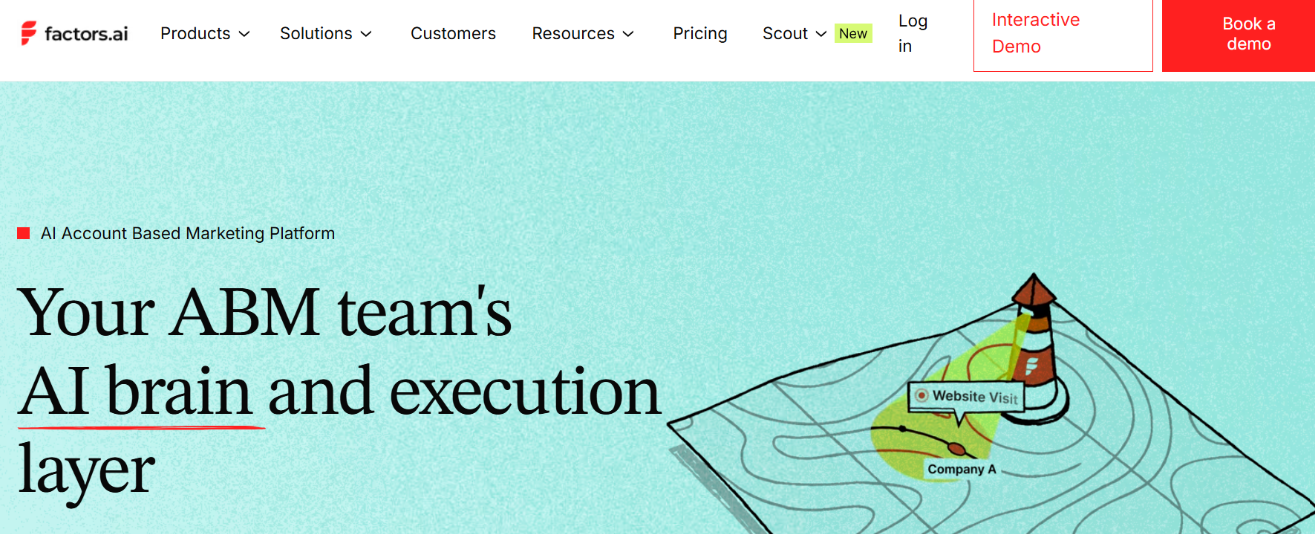
Key Features
- Visitor identification: Reveals companies and some individuals.
- Attribution analytics: Ties visits to marketing performance.
- Intent and workflows: Triggers actions on engagement.
- Integrations: Connects with CRMs and ad platforms.
Pros
- Analytics plus ID: Useful for measuring marketing impact.
- Workflow triggers: Automates some follow-up steps.
- Good for marketers: Strong reporting layer.
Cons
- Learning curve: The analytics depth takes time to use well.
- Person-level gaps: Individual identification is not its core strength.
- Setup effort: Configuration needed for full value.
Pricing: Free plan available. Paid plans are custom-quoted based on traffic and features.
Best for: Marketing teams that want identification tied to attribution and analytics. Less ideal if you only need clean, person-level leads.
9. Albacross
Albacross is a B2B lead generation tool built primarily for the European market. It identifies companies and supports account-based campaigns and alerts. It is an affordable European option, yet it stays largely company-level. Person-level detail and autonomous outreach are not its focus.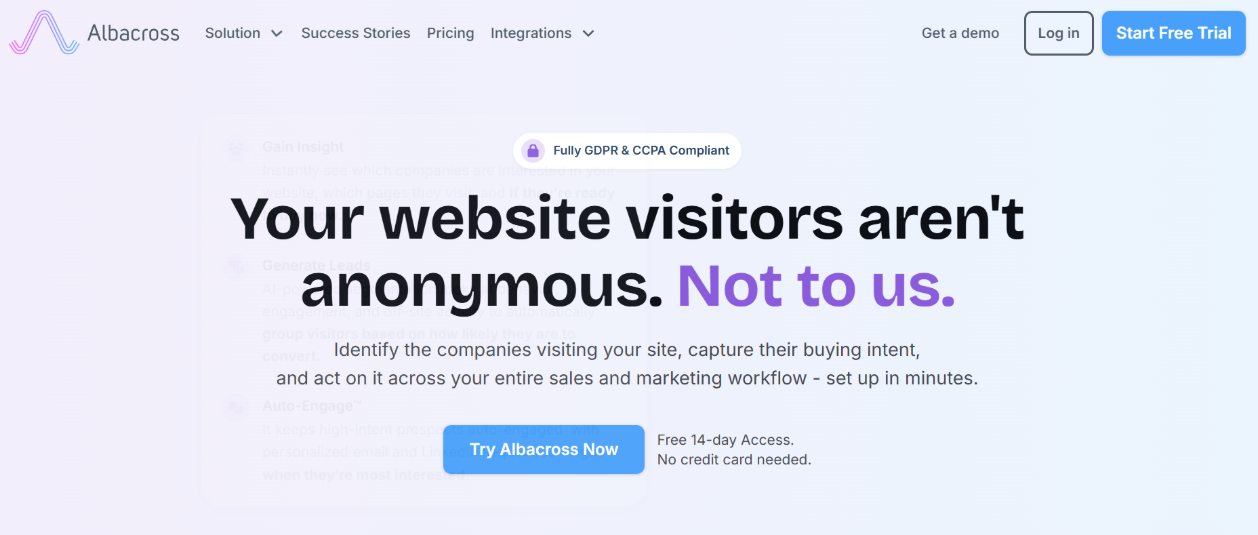
Key Features
- Company identification: Reveals companies visiting your site.
- ICP alerts: Notifies you when target-fit companies engage.
- ABM campaigns: Supports account-based targeting.
- Intent data: Provides signals on captured accounts.
Pros
- Strong EU coverage: Native strength in European markets.
- User-friendly: Reviewers on G2 note ease of use.
- ABM support: Handy for account-based motions.
Cons
- Company-level focus: Limited person-level identification.
- No native nurture: Outreach happens in other tools.
- Best in Europe: Coverage is strongest in the EU.
Pricing: Paid plans start around $117/month, billed by identified leads, with a free trial available.
Best for: European teams running account-based marketing on a budget. A reasonable fit when EU coverage is the priority.
10. Leadinfo
Leadinfo is a Dutch platform focused on visitor identification for European teams. It offers transparent pricing, strong integrations, and GDPR-aware tracking. It performs well in European markets and connects widely. Like most in this group, it centres on company-level data.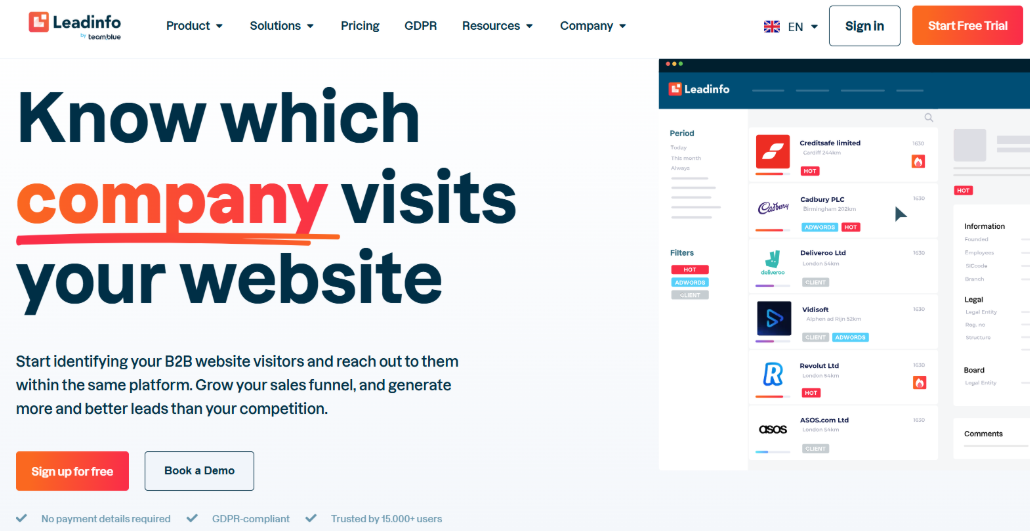
Key Features
- Company identification: Real-time reveal of visiting companies.
- Transparent pricing: Clear, published plans.
- Many integrations: Supports a wide integration library.
- Cookieless tracking: Privacy-aware data collection.
Pros
- Clear pricing: No opaque quote games.
- EU strength: Reliable identification in European markets.
- Broad integrations: Fits neatly into existing stacks.
Cons
- Company-level focus: Limited individual identification.
- Regional strength: Best inside Europe.
- No autonomous outreach: Follow-up remains manual.
Pricing: 14-day free trial. Paid plans start around EUR 69/month (Starter) and scale to about EUR 359/month.
Best for: European teams that value transparent pricing and GDPR-aware tracking. Solid when company-level insight is enough.
11. Happierleads: Best for Budget Person-Level Identification
Happierleads reveals both the companies and the individual people visiting your website, then pushes them to your CRM and Slack. It targets small and mid-sized teams that want person-level data without enterprise pricing. It identifies visitors across desktop and mobile and supports remote-worker matching. Its outreach and scoring depth stay lighter than a full AI Business Developer.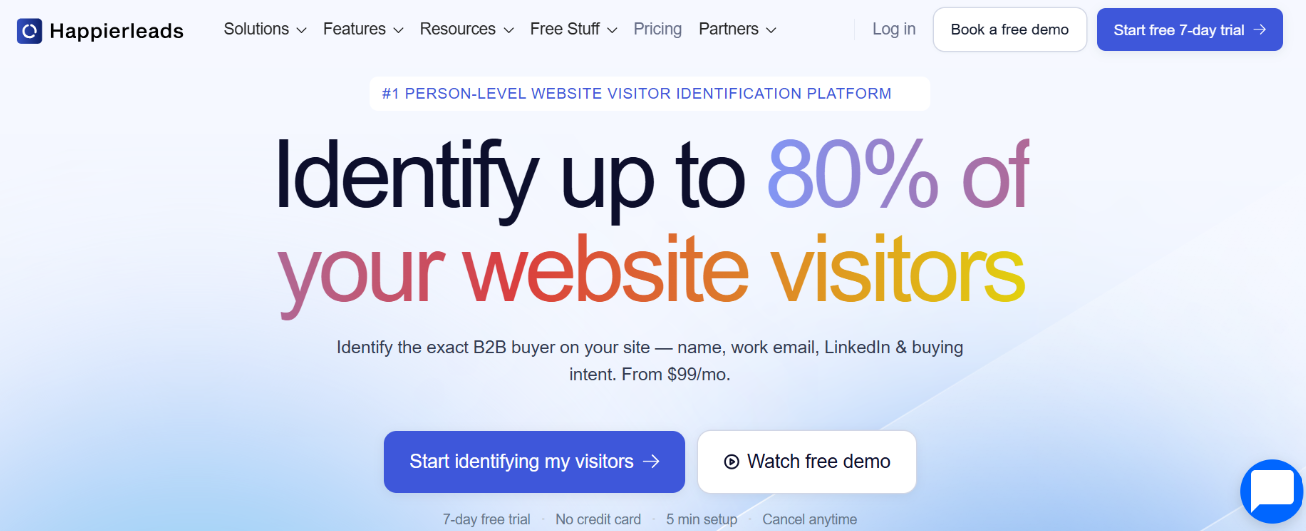
Key Features
- Person and company identification: Reveals people and companies, with names, roles, and business emails where available.
- Remote-worker matching: Identifies visitors working from home, not just office IPs.
- Segmentation and filters: Sorts visitors by ICP criteria like industry, size, and location.
- CRM and Slack alerts: Sends identified leads into your existing sales stack.
Pros
- Person-level on a budget: Individual data at an SMB-friendly price.
- Wide coverage: Works across desktop, mobile, and remote traffic.
- Simple setup: Fast to install and start seeing visitors.
Cons
- Lighter automation: No autonomous email sequences or handoff loop.
- Scoring depth: Intent scoring is basic next to specialist tools.
- Data gaps: Match quality varies by region and traffic, per user reviews on G2.
Pricing: 7-day free trial. Paid plans start around $99/month, scaling by identified visitors.
Best for: Small and mid-sized teams that want person-level identification without an enterprise contract. A fair pick when budget matters more than automation.
12. Snitcher: Best for Enriched Visitor Identification and Segmentation
Snitcher reveals which companies visit in real time and enriches them for outreach. It leans on segmentation to help teams prioritise. It offers solid company-level data and integrations. Person-level identification and native outreach are not its core.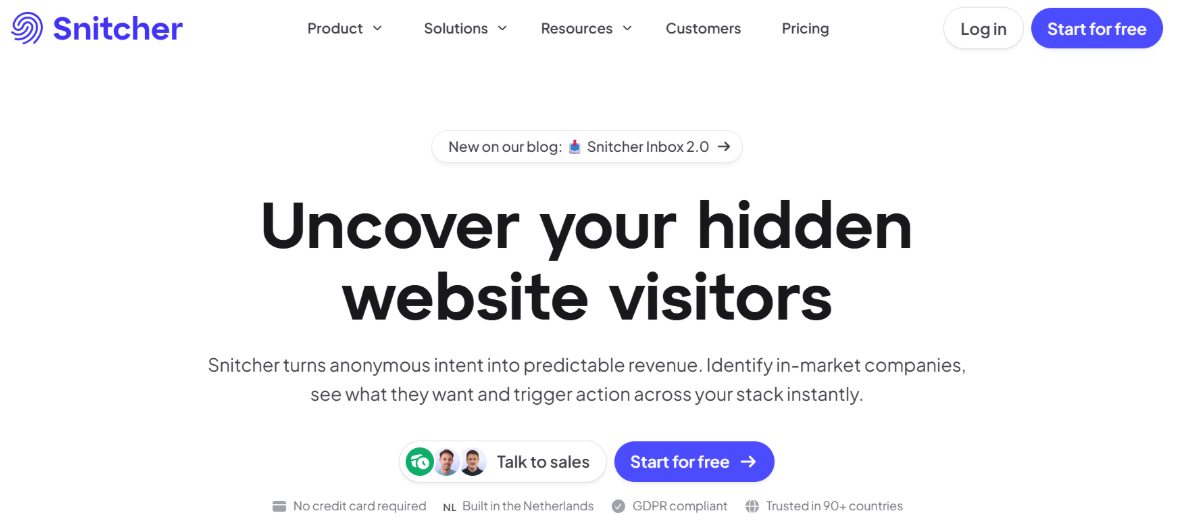
Key Features
- Real-time reveal: Identifies visiting companies as they browse.
- Data enrichment: Adds firmographic detail to each company.
- Segmentation: Groups visitors for targeted follow-up.
- Integrations: Connects with CRMs and marketing tools.
Pros
- Fast identification: Real-time company reveals.
- Useful segments: Helps prioritise accounts.
- Clean data: Reliable firmographic enrichment.
Cons
- Company-level focus: Limited person-level identification.
- No autonomous nurture: Outreach lives elsewhere.
- Scaling costs: Bill rises with volume.
Pricing: 14-day free trial. Paid plans start around $49/month ($35/month billed annually), usage-based.
Best for: Teams that want enriched company data and clean segmentation. A fair fit when person-level detail is not essential.
13. Cognism
Cognism is a sales intelligence platform known for phone-verified contact data and compliance. It suits outbound teams that need accurate mobile numbers. It is contact-data first, not a website visitor identification engine.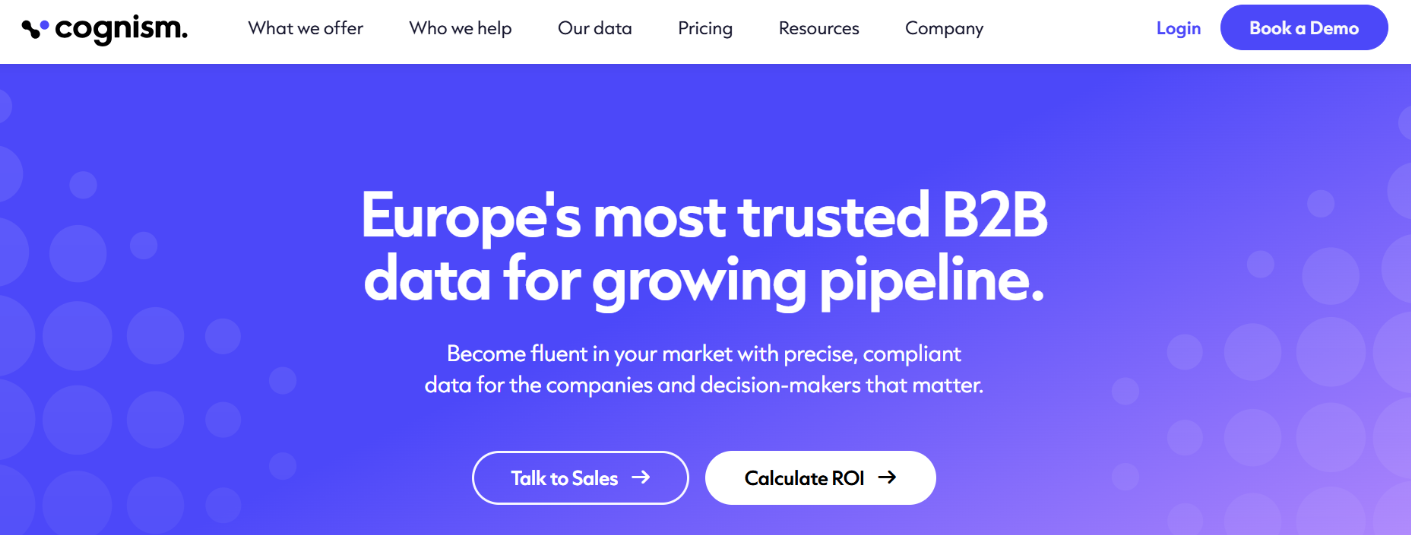
Key Features
- Phone-verified data: Human-checked mobile numbers.
- Compliance focus: Built for GDPR-aware outbound.
- Contact database: Broad B2B contact records.
- CRM integrations: Feeds data into sales tools.
Pros
- Accurate numbers: Strong phone-verified data.
- Compliance-minded: Good for regulated outbound.
- Global contacts: Coverage across regions.
Cons
- No visitor ID: Does not identify anonymous website visitors.
- Database pricing: Costs scale with data needs.
- Manual outreach: No autonomous follow-up.
Pricing: No public pricing. Custom annual contracts, typically premium enterprise pricing (often $10,000+/year).
Best for: Outbound teams that prioritise phone-verified, compliant contact data. Best used alongside a visitor identification tool, not instead of one.
14. UpLead
UpLead is a B2B contact database focused on verified emails and real-time verification. It suits teams building targeted outbound lists. It is a data provider, not a website visitor identification platform. Activation happens in your sequencing tool.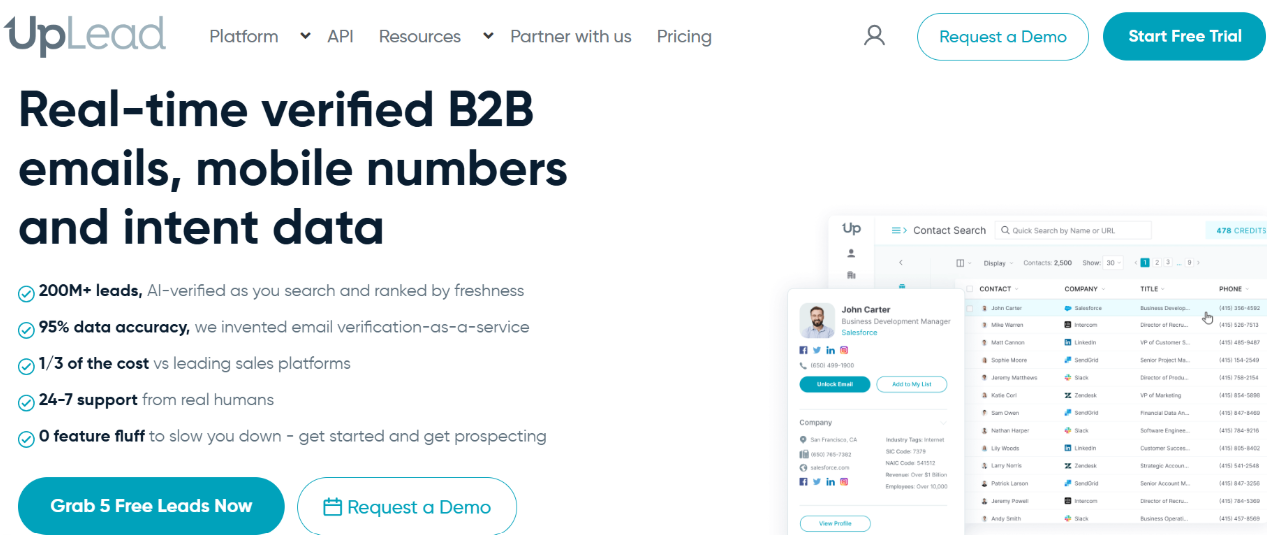
Key Features
- Verified emails: Real-time email verification.
- Contact database: Searchable B2B records with filters.
- Enrichment: Adds detail to existing records.
- Integrations: Exports cleanly to CRMs.
Pros
- High data accuracy: Verified contacts reduce bounces.
- Simple search: Easy list building.
- Good enrichment: Fills record gaps.
Cons
- No visitor ID: Does not reveal your website visitors.
- Manual outreach: No built-in nurturing.
- Credit limits: Usage tied to credits.
Pricing: 7-day free trial. Paid plans start around $99/month (Essentials) and $199/month (Plus).
Best for: Teams that want verified contact data for outbound campaigns. A list-building tool rather than an inbound identification engine.
15. Apollo.io
Apollo.io combines a large contact database with built-in sequencing and a generous free tier. It suits outbound teams that want data and outreach in one tool. It focuses on cold prospecting, not person-level website identification. Our Apollo.io alternatives guide covers the trade-offs.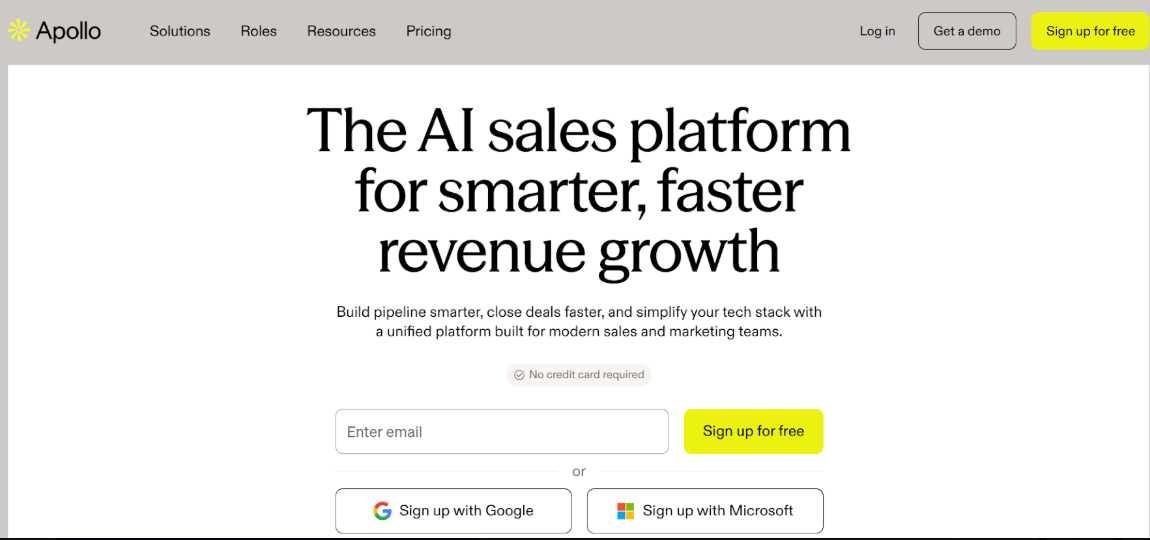
Key Features
- Large database: Extensive B2B contact records.
- Built-in sequencing: Email outreach inside the platform.
- Enrichment and filters: Detailed search and record enrichment.
- CRM integrations: Syncs with common tools.
Pros
- All-in-one: Data and outreach together.
- Generous free tier: Easy to start testing.
- Strong for outbound: Good for cold prospecting at scale.
Cons
- No visitor ID: Does not identify anonymous website visitors.
- Data varies: Accuracy shifts by region and record.
- Cold-first: Built for outbound, not inbound capture.
Pricing: Free plan available. Paid plans start around $49/month, scaling with credits and features.
Best for: Outbound teams that want prospecting data and sequencing in one place. Less suited to converting inbound website traffic.
How We Chose These Lead Forensics Alternatives
We compared every tool based on the features that matter most for identifying website visitors, qualifying leads, and helping sales teams generate more revenue.
- Person-Level Identification: We preferred tools that identify the actual visitor instead of only showing the company name.
- Buyer Intent: We looked for platforms that measure how likely a visitor is to become a customer based on their website activity.
- Real-Time Alerts: We gave higher scores to tools that instantly notify your team when a high-value visitor lands on your website.
- Outreach Automation: We favored platforms that can automatically contact qualified visitors or hand them to your sales team.
- Integrations: We checked how well each tool connects with popular CRMs, Slack, and other sales and marketing platforms.
- Lead Scoring: We looked for tools that rank visitors based on customer fit and buying intent, making it easier to prioritize the best opportunities.
- Compliance & Data Privacy: We considered whether each platform uses trusted data sources and follows standards like GDPR, CCPA, and SOC 2.
- Pricing & Value: We compared pricing transparency, free plans or trials, and the overall value each platform offers.
Also Read: Leadfeeder Alternatives: Top Website Visitor Identification Tools
Now that you have seen how all fifteen tools compare, let us look closely at why Kwin sits at the top of this list.
Why Kwin Ranks #1 Among Lead Forensics Alternatives
Kwin ranks first because she does more than identify website visitors. She identifies both the company and the person, scores buying intent, automatically reaches out to qualified visitors, and hands sales-ready leads to your team.
With person-level identification across 175+ countries and proven customer results, including 2.5x more qualified leads in 45 days, Kwin helps businesses turn anonymous website traffic into booked meetings instead of just another report.
What makes Kwin stand out:
- Person and company identification: Names, work emails, phone numbers, and LinkedIn profiles, plus company revenue, industry, and location, at 60 to 70% of visitors across 175+ countries.
- Fit and intent scoring: An ICP fit score and a Purchase Intent score, so Kwin acts only on visitors worth your team's time.
- Threshold control: You set the minimum ICP fit and Purchase Intent score, and Kwin acts only once a visitor crosses it.
- Autonomous outreach and handoff: A personalised email sequence from your own domain, positive replies forwarded to your inbox, and hot leads pushed to Slack and your CRM.
- Free forever entry: The Lead Watcher plan is free forever, with 100 leads per month and no credit card.
- Fast, compliant setup: A 5-minute pixel install, backed by SOC 2 Type II, GDPR, CCPA, and ISO certification.
Book Your Free Demo to see person-level identification live on your own traffic.
How to Choose the Right Lead Forensics Alternative
The right tool depends on your team, your region, and what you count as success. Use these five questions to narrow your shortlist fast.
1. Match the Tool to the Job (Inbound Capture vs Outbound Lists)
Decide what you are really solving. If you want to convert the buyers already on your site, choose a visitor identification tool with outreach. Then pair it with the matching channel, like SEO and content traffic. If you need cold lists for outbound, a contact database fits better. Kwin is built for the first job, turning inbound traffic into meetings.
2. Weigh Region and Coverage
Your traffic map should drive the pick. US-heavy teams may accept a US-focused tool, while global teams cannot. Check where each platform actually identifies visitors well, not just where it claims to. Kwin covers 175+ countries, which suits teams selling worldwide.
3. Decide Person-Level vs Company-Level
Be honest about how your reps work. If a company name is enough for your motion, company-level tools will do. If your team needs the person, the title, and a way to reach them, insist on person-level identification. That single choice removes half the shortlist quickly.
4. Factor In Activation, Not Just Identification
Identification without action is a slow win. Ask whether the tool only reports, or whether it can score, email, and hand off automatically. Tools that stop at data leave the work to you, while an AI Business Developer closes the loop. This is where Kwin separates from the rest of the list.
5. Check Compliance and Data Sourcing
Trust protects your brand, so vet how each tool sources its data. Ask whether it works from publicly available business data and holds recognised certifications. The strongest options are transparent about consent and governance. Kwin is SOC 2 Type II, GDPR, and CCPA aligned, plus ISO 9001:2015 and ISO 27001:2022 certified.
Best tool by use case:
Conclusion
Lead Forensics helped teams see which companies visited, and that was useful for a long time. The bar has moved. Modern buyers stay anonymous, research in bursts, and rarely fill out a form, so a company name is no longer enough.
The best lead forensics alternatives identify the person, score real intent, and act while attention is warm. Kwin leads that group, turning anonymous traffic into booked meetings on autopilot.
We hope this guide helped you understand your options and how each tool fits a different kind of team. Now it is your turn to put a shortlist to the test on your own traffic and see who your visitors really are.
If you want a hand mapping the right setup, hire Kwin for free and turn anonymous traffic into booked meetings, no credit card required.