
TL;DR
- The Core Problem: Lusha is a fantastic manual lookup tool (via its Chrome Extension), but it is entirely passive. You have to manually search for a prospect, click to reveal their data, burn a credit, and then write the email yourself.
- The Direct Answer: If you have the time to manually hunt for contacts on LinkedIn one by one, keep Lusha. If you want an AI that autonomously identifies anonymous website visitors and emails them for you 24/7, switch to Kwin by Vison AI.
- The Verdict: Kwin eliminates the manual prospecting bottleneck. It doesn't just give you a phone number; it actually books the meeting.
- Fast Facts:
- The Workflow: Lusha = Manual click-to-reveal. Kwin = Autonomous identification & outreach.
- Visitor ID: Lusha = Primarily outbound search. Kwin = Inbound Person-Level tracking across 175+ countries.
- The Cost Trap: Lusha charges you credits just to see the data. Kwin includes the AI outreach for free once the lead is identified.
For B2B revenue teams identifying website visitors in 2026, is the need of the hour because the search game has fundamentally changed. The rise of AI Discovery has completely altered how buyers research software. Most users now learn about a brand through direct answers from LLMs like ChatGPT, Gemini, or Perplexity.
By the time they actually click through to your domain, they are performing their final evaluation before making a purchase. This means overall website traffic is down across the board. However, the intent of the traffic you do receive has skyrocketed.
Because these visitors are in the final stage of making a purchase decision, knowing how to identify website visitors the second they land on your page is critical. You might be staring at your analytics dashboard asking, "exactly who visits my website?" To identify who visits your website and capture them before they leave, you need modern website visitor identification software.
Unfortunately, 98% of these high-intent buyers still left the website without ever filling out a form. Relying on manual database extensions to track website visitors simply does not work. In this guide, we will explore how to identify anonymous website visitors automatically. We will break down the top Lusha alternatives that bridge the gap between static contact data and active, person-level B2B sales execution.
A Deep Dive into Lusha
Before evaluating alternatives, we must address Lusha's current standing in the market. Lusha is widely known as a tactical browser extension used by sales reps to reveal contact information on LinkedIn. It is a massive B2B database that helps individual contributors find direct dials and emails.
However, as B2B sales shift toward signal-based, automated inbound engagement, many teams realize Lusha is merely a data provider. It requires significant manual effort from SDRs to click, reveal, export,enrich and sequence leads. To provide a factual analysis, we conducted deep internet research across verified reviews on G2 and TrustRadius from late 2025 and early 2026. Here is the unvarnished reality of the platform.
Pros of Lusha
- Seamless LinkedIn Integration: Lusha’s Chrome extension is highly praised for being frictionless, allowing reps to reveal contact details directly over a prospect's social profile.
- Easy to Use: The platform requires almost no implementation time, making it incredibly accessible for new sales hires to start prospecting immediately.
- Accurate Direct Dials: Users frequently note that Lusha provides highly accurate direct mobile numbers for contacts in the United States.
Cons of Lusha
- High Credit Burn: Lusha operates on a strict credit model where revealing a phone number costs significantly more than revealing an email, draining monthly limits rapidly. High pricing for premium features, with opaque custom quotes for enterprise plans and unexpected renewal increases.
- Regional Data Gaps: While US data is strong, users frequently complain that finding accurate, verified phone numbers for clients outside North America is highly difficult.
- Passive Manual Workflow: Lusha does not identify visitors on your website or automate outreach. It strictly relies on reps manually hunting for prospects one by one.
- Poor Support: Limited customer support, with slow response times and inadequate assistance for non-enterprise users. Ethical concerns around data sourcing, with complaints of "stolen" or unsolicited personal information leading to privacy violations.
Verified Customer Feedback & References
User sentiment across major review platforms highlights a growing frustration with unpredictable pricing and data accuracy outside the US.
Expensive & Restrictive Credits
Review by Akhil J on G2 Review

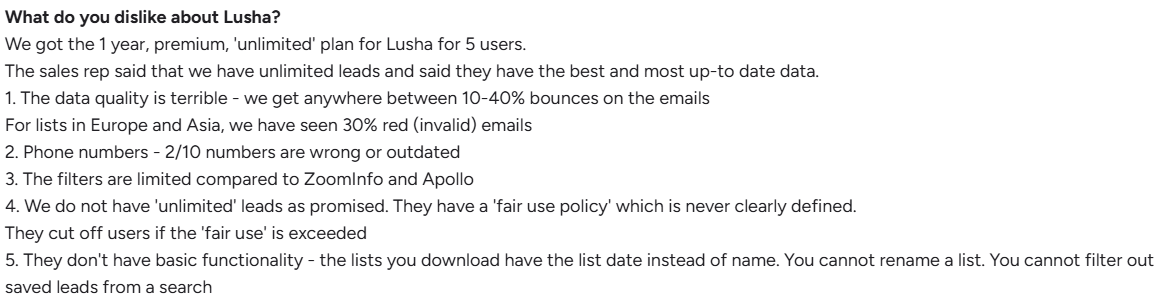
The Data Inaccuracy and Bugs
Review by Nikita A on G2 Review
Source: capterra
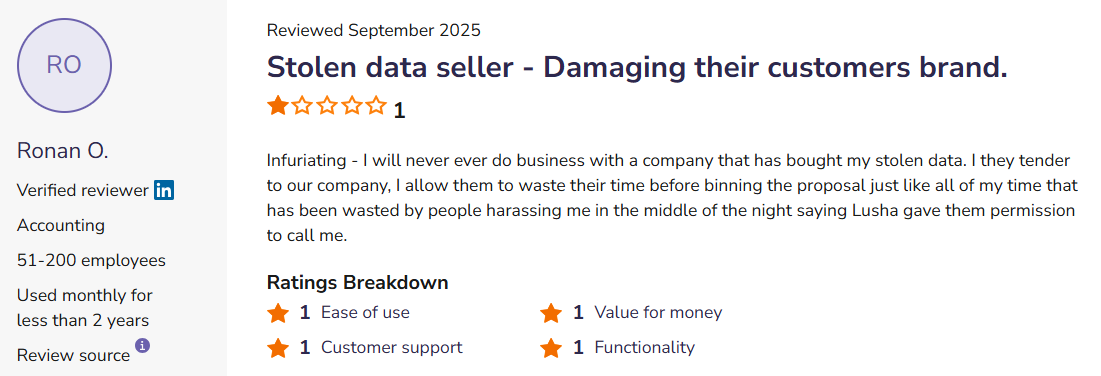
Data Stealing Accusation
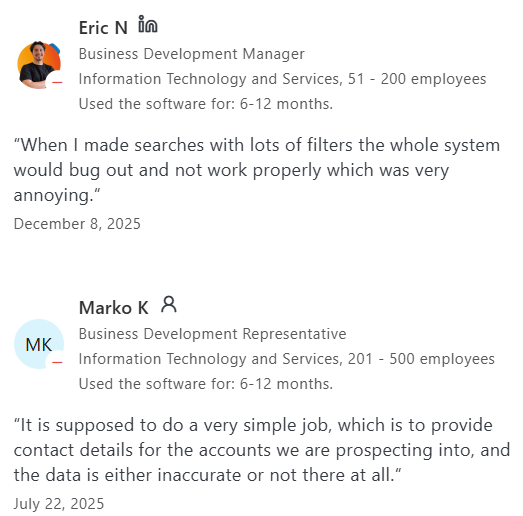
Review by Ronan O on Software Advice
Poor Support
Source: Infotech

Comparison Table of the Top 11 Tools (Kwin)
Let's look at the architectural differences between manual database extensions, passive analytics, and active AI agents. This table breaks down the top 11 tools for website visitor tracking.
Top 11 Lusha Alternatives for Person-Level Visitor Identification & Sales
If you want to understand how to track website visitors effectively, you must move beyond browser extensions. Here is the deep-dive analysis of the top 11 website visitor tracking tools available today.
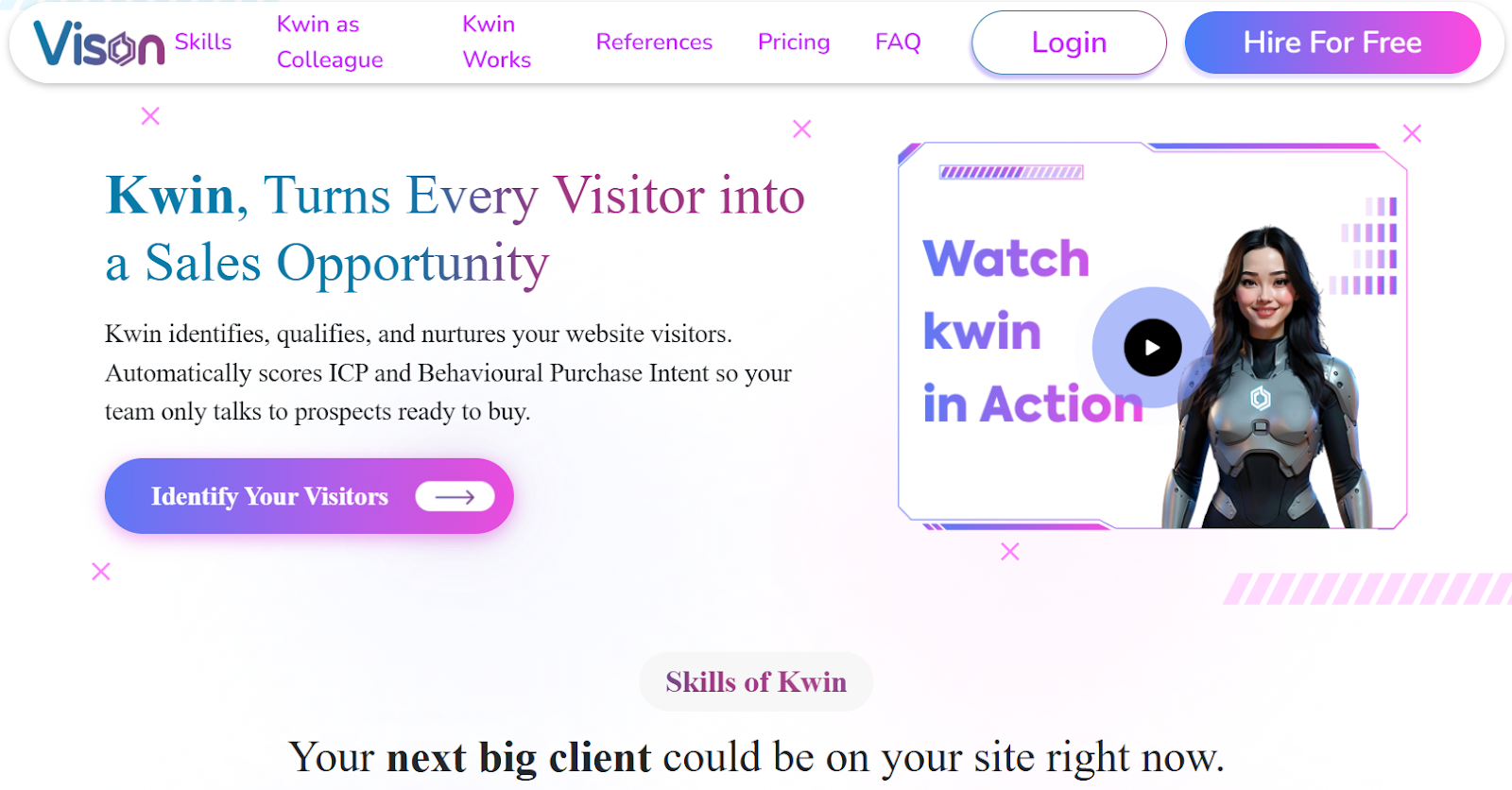
1. Kwin by Vison AI
Kwin is not just website visitor identification software; she is an autonomous AI Business Developer that multiplies your sales efforts. As AI Discovery engines steal general traffic, the visitors landing on your site today are highly qualified. Kwin captures these high-intent leads by identifying anonymous website visitors at the exact person-level across 175+ countries.
Feature | Kwin (AI Employee) | Lusha (Database / Extension) |
|---|---|---|
Primary Function | Active Conversion (Emails inbound leads) | Passive Lookup (You search for outbound leads) |
Workflow | Zero-Touch (Set it and forget it) | High-Touch (Search -> Click Reveal -> Export) |
Global Reach | 175+ Countries (Included) | US-Centric (International data can be spotty) |
Outreach | Autonomous (Multi-channel included) | Manual (Requires a separate sequencing tool) |
Free Plan | 100 Leads/Month Forever | 5 Credits/Month (Extremely limited) |
Pros:
- Kwin automatically crawls your website to create a business knowledge base, deriving your Ideal Customer Profile (ICP) without manual setup.
- She calculates a Purchase Intent Score (PIS) based on the identified visitor’s browsing behavior on your site.
- If both the ICP and PIS match your set threshold, Kwin automatically drafts highly personalized messages and adds them to a multi-channel outreach sequence via Email and LinkedIn.
- Offers a free forever plan (100 leads/month). Subscription costs start at $75 USD per month, dropping to $56 USD per month on an annual plan.
Cons:
- It requires a mindset shift from sales leaders who must learn to trust an AI employee with initial prospect engagement.
- While Kwin has a free forever plan, scaling high-volume outreach requires a paid subscription.
Best For: B2B SaaS companies, agencies, and high-growth startups that want to multiply inbound conversions without hiring more human SDRs.
Still paying for legacy databases?
Lusha gives you legacy passive data; Kwin gives you booked meetings. While legacy tools rely on outdated lists, Kwin deanonymizes your active website visitors across 175+ countries and automatically executes personalized outreach based on real-time buying intent.
Hire Kwin For Free(100 Leads per Month Free Forever) →
Test our global pixel with 100 free leads per month. No credit card required.
2. RB2B
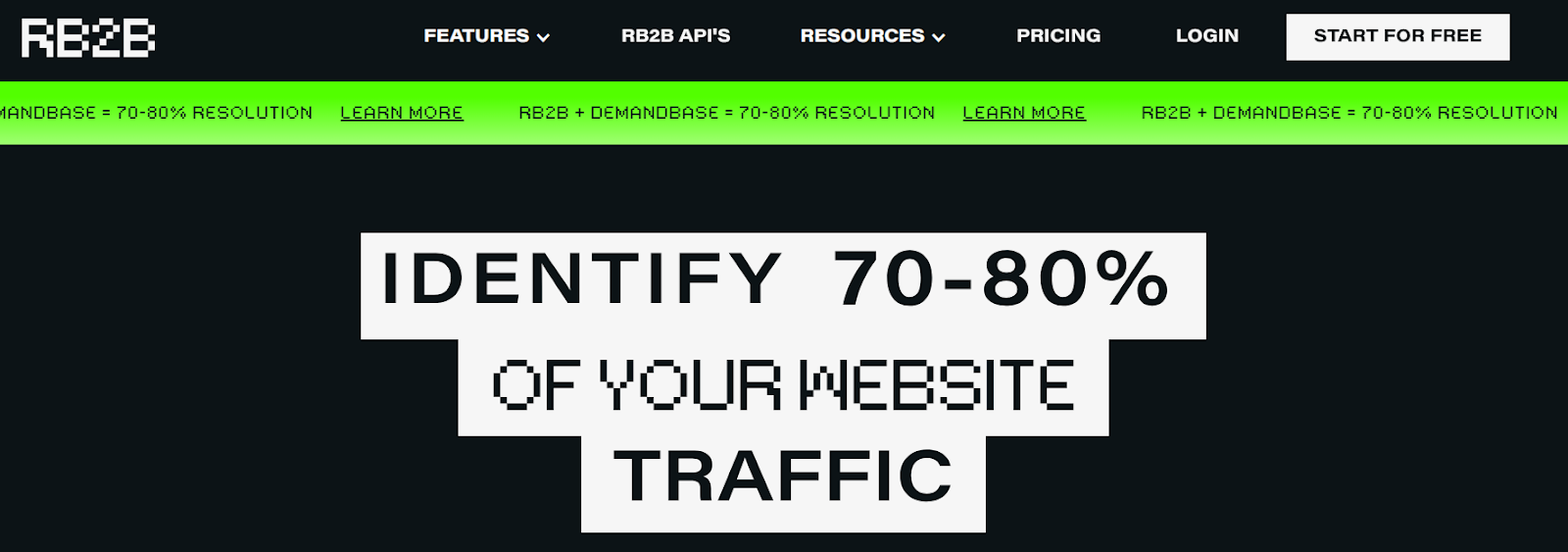
RB2B has surged in popularity as a lightweight, tactical tool to identify who visits your website. Instead of living in complex dashboards, RB2B identifies the visitor and pushes their exact LinkedIn profile directly to a designated Slack channel.
Source:RB2B
Pros:
- Frictionless setup allows you to install the tracking pixel and start receiving Slack alerts in under five minutes.
- Provides highly accurate person-level website visitor data, specifically focusing on LinkedIn URLs for easy social selling.
Cons:
- It operates strictly as an alert system; your human reps still have to manually click the profile and type the outreach message.
- Person-level identification is heavily restricted to United States traffic; international traffic is only identified at the company level.
- The free tier is generous, but paid plans for higher volume start at a steep $149/month.
Best For: Solo founders, agile SDRs, and small marketing teams who live in Slack and execute highly manual, bespoke outreach.
3. Warmly
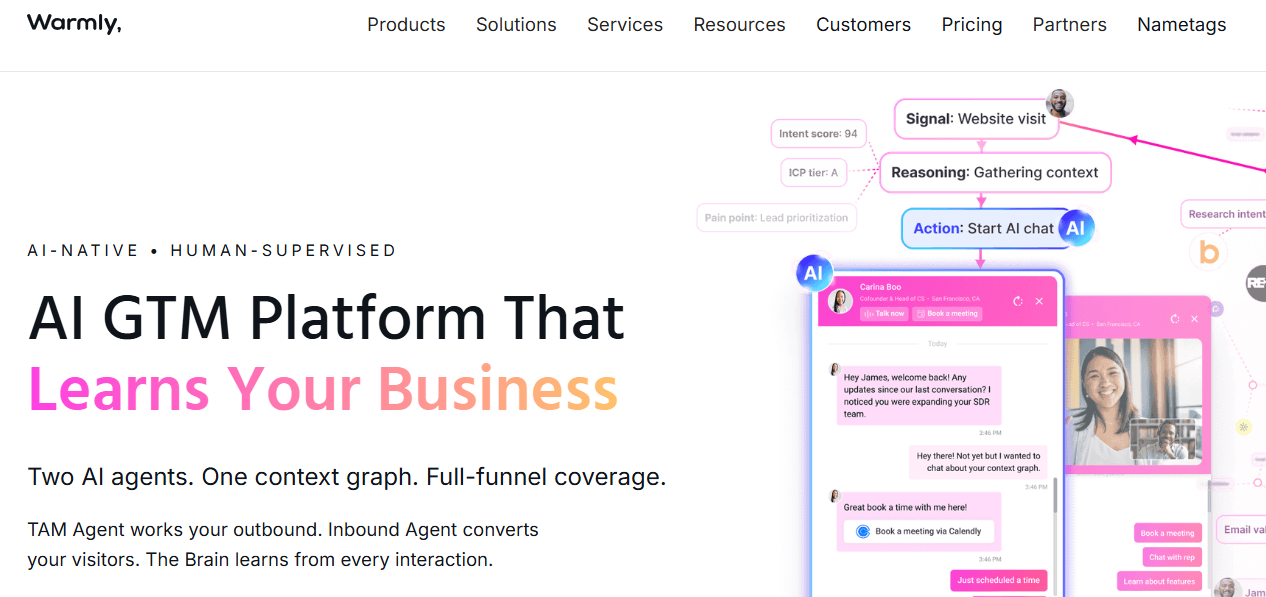
Warmly is an AI-powered revenue orchestration platform built for mid-market teams focusing on website visitor data. It aggregates site visits alongside third-party intent signals and job changes to give a holistic view of buyer intent.
Source:Warmly
Pros:
- Combines first-party website data with third-party intent signals to create a complete view of an account's readiness to buy.
- The AI chatbot feature allows teams to engage high-value accounts instantly while they are still browsing the pricing page.
Cons:
- The pricing jump from the free tier to the paid tier is massive, effectively pricing out early-stage startups.
- Paid plans jump steeply, starting around $700/month or $15,000 annually for full features.
- Like most legacy tools, its person-level visitor ID accuracy drops significantly for smaller businesses or remote workers.
Best For: Mid-market B2B teams looking for a comprehensive signal-based platform that combines intent data with live website chat.
4. Leadfeeder (by Dealfront)
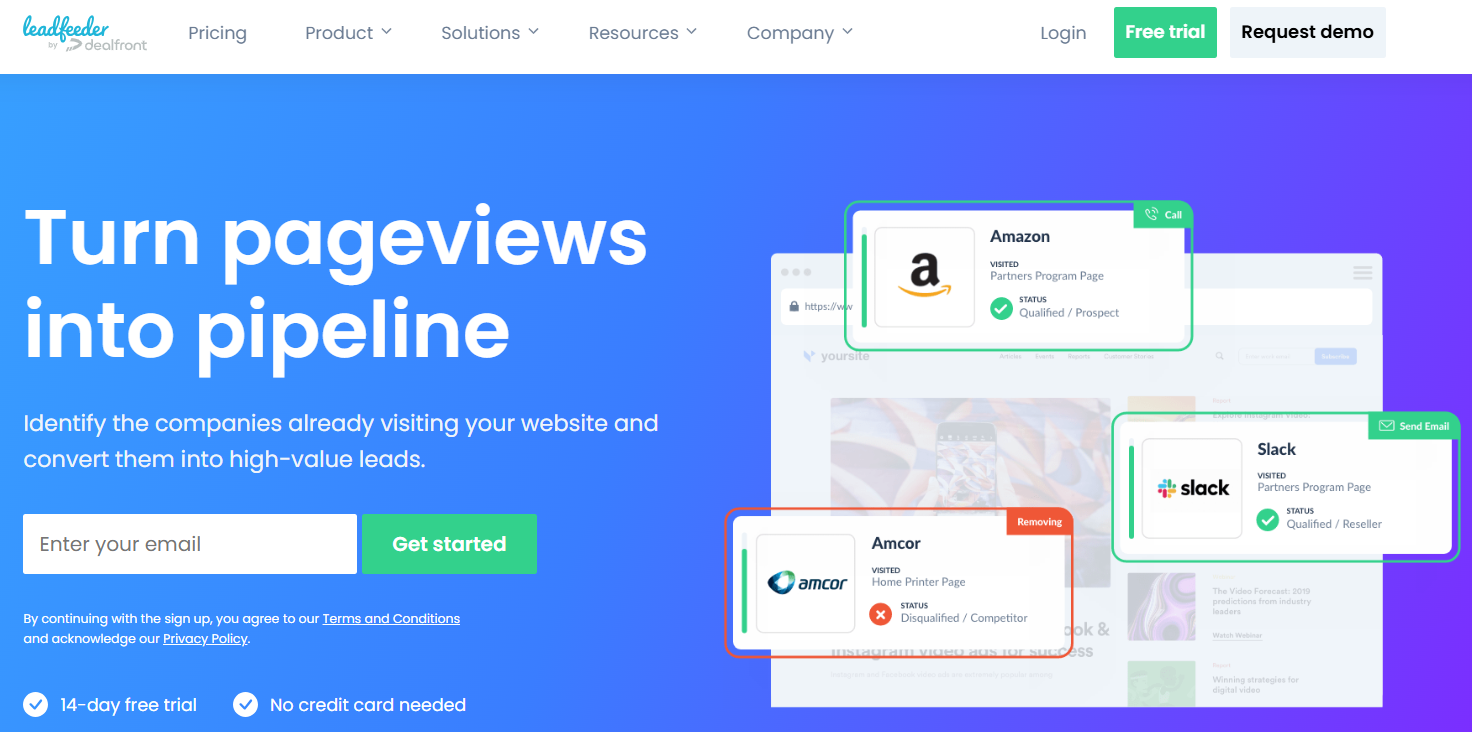
Leadfeeder is one of the foundational website visitor tracking tools for marketing attribution. It excels at showing you exactly how companies found your website and which specific pages they spent the most time reading.
Source:Leadfeeder
Pros:
- The user interface is exceptionally clean, making it easy for marketing teams to build visual reports on content performance.
- Deep integrations with standard CRMs allow for seamless pushing of account-level data to sales teams.
Cons:
- It is strictly an account-level tool, meaning it will tell you "Microsoft" visited your site, but not if it was the CEO or an intern.
- Starts around $139/month, with pricing scaling based on the volume of unique companies identified.
- It provides passive data only; there are no built-in sequencing capabilities to immediately message the lead.
Best For: Demand generation marketers who need to prove the ROI of their content and provide account-level targeting lists.
5. 6sense
6sense is an enterprise behemoth designed to illuminate the "Dark Funnel" for complex B2B sales. It uses predictive models to identify B2B buying committees researching your industry across the web, long before they ever land on your domain.
Source:6sense
Pros:
- Unmatched predictive AI tells you exactly which accounts are "in-market" to buy, allowing you to prioritize enterprise sales.
- Maps out entire buying groups rather than focusing on a single point of contact.
Cons:
- The implementation process is notoriously complex, often requiring a dedicated RevOps engineer to manage the system.
- The price tag is exclusionary, built purely for well-funded enterprise organizations.
- Custom enterprise pricing, typically starting north of $30,000 to $50,000 per year.
Best For: Fortune 500 companies and large enterprise teams running highly sophisticated Account-Based Marketing (ABM) motions.
6. Albacross
If you are asking how to know who visits your website within the European Union, Albacross is a prime candidate. Built from the ground up to comply with stringent GDPR laws, it safely identifies company-level traffic across European markets.
Source:Albacross
Pros:
- "Privacy-first" architecture ensures absolute compliance with EU data protection regulations.
- Provides highly accurate firmographic data for European companies, a region where US-centric tools often struggle.
Cons:
- It stops at the company level, requiring you to manually hunt down specific decision-makers on LinkedIn.
- Its data coverage and accuracy drop significantly when trying to identify North American or Asian traffic.
- Custom pricing based on web traffic volume, generally starting around $100 per month.
Best For: European-based sales teams or global companies strictly targeting the EU market where data compliance is the highest priority.
7. Factors AI
Factors AI is a marketing website visitor analytics powerhouse designed to solve complex multi-touch attribution. It merges data from LinkedIn ads, G2 buyer intent, and your own website visitor data to map the exact journey an account took before converting.
Source:Factors AI
Pros:
- Provides granular visibility into which specific marketing campaigns are actually driving revenue.
- Excellent timeline view merges disparate intent signals into a single, chronological account journey.
Cons:
- It is a passive dashboard tool that analyzes traffic but relies entirely on human reps to execute the actual sales outreach.
- Users frequently report a steep learning curve and a complex user interface that takes weeks to master.
- Starts at $399/month, but essential ABM features are expensive add-ons that push costs over $2,000/month.
Best For: Performance marketers and growth leads who need deep, mathematical attribution for high-spend advertising campaigns.
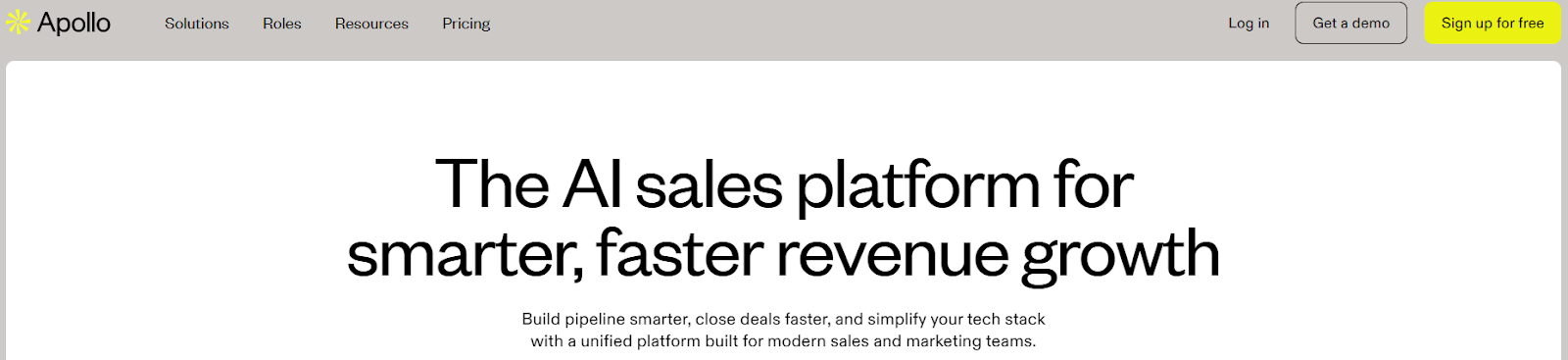
8. Apollo.io
Apollo.io is for high-volume outbound sales and cold email sequencing. It combines one of the world's largest B2B contact databases with a built-in email sequencer, acting as a direct competitor to Lusha's core offering.
Source:Apollo.io
Pros:
- Incredible price-to-value ratio; you get a massive database, sequencer, and dialer for a very low entry cost.
- Its "WebSights" feature provides basic company-level visitor tracking as part of the overall package.
- Basic paid plans start at $49/user/month, but require careful management of export credits.
Cons:
- High data decay is a known issue; because the platform is so accessible, the database burns out quickly, leading to email bounces.
- Website visitor tracking is strictly company-level, meaning you still have to manually search the database to guess the right contact.
Best For: Budget-conscious startups and high-volume outbound teams that rely heavily on cold email tactics.
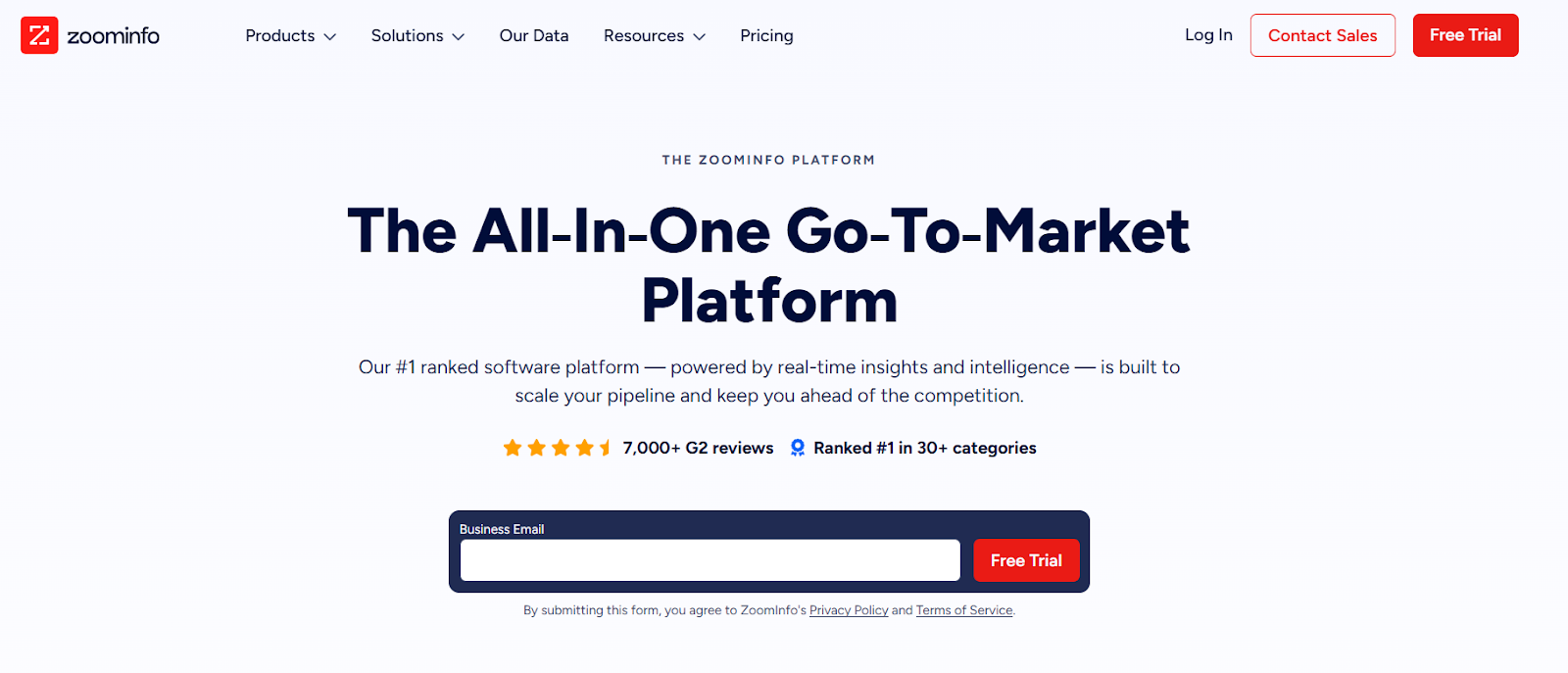
9. ZoomInfo
ZoomInfo is the traditional heavyweight champion of B2B data and sales intelligence. If you need a raw database with millions of direct dials and verified emails, ZoomInfo has the deepest well of data in North America.
Source:Zoominfo
Pros:
- Unrivaled contact database scale for US-based enterprise companies and massive call centers.
- Deep, enterprise-grade integrations with complex CRM instances like Salesforce.
Cons:
- Requires massive, multi-year contracts with notoriously inflexible auto-renewal clauses.
- The "WebSights" visitor tracking feature is company-level, so you still rely on human SDRs to sift through the data and make the calls.
- No public pricing. Contracts typically start around $15,000 to $25,000 per year paid upfront.
Best For: Massive outbound call centers and enterprise sales teams that require millions of raw records for cold calling.
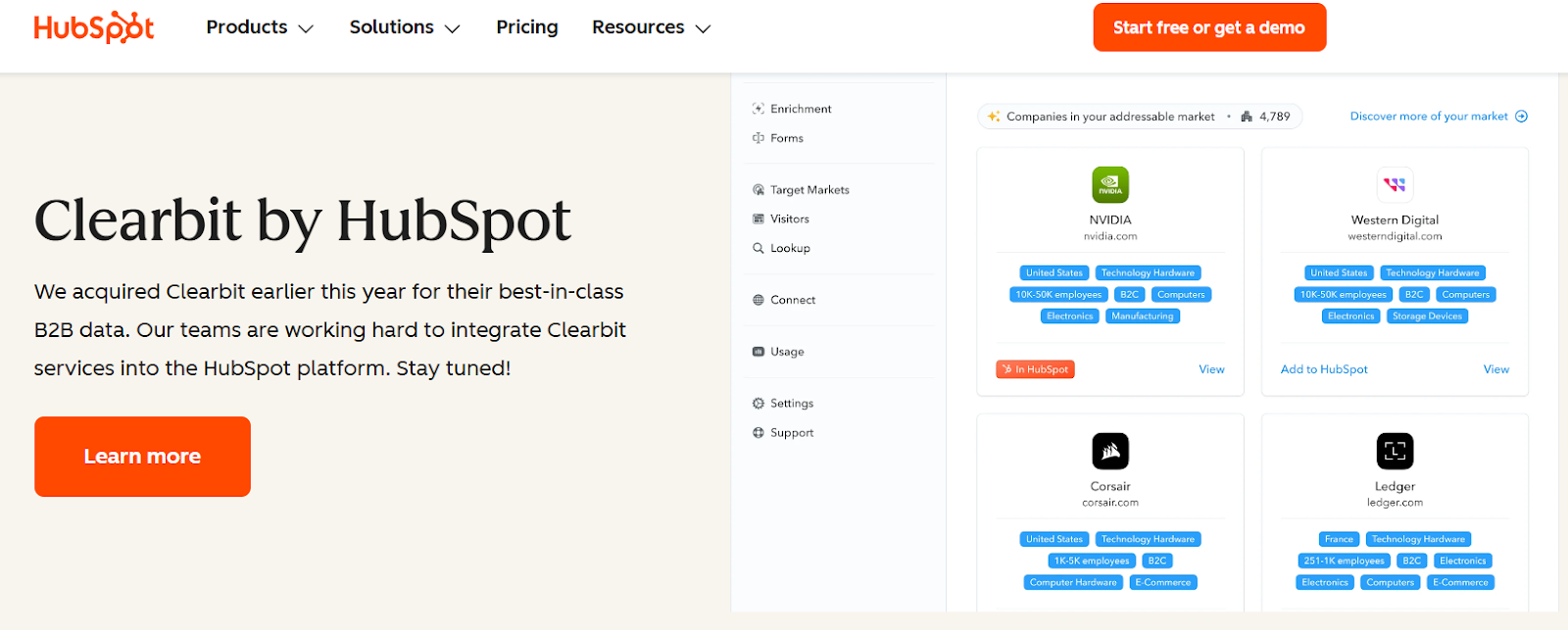
10. Clearbit (Breeze Intelligence)
Intro: Following its acquisition by HubSpot, Clearbit is now known as Breeze Intelligence. It is fundamentally a data enrichment API designed to automatically append firmographic data to inbound leads as they enter your CRM.
Source:Hubspot
Pros:
- Flawless native integration for teams operating entirely within the HubSpot ecosystem.
- Excellent form-shortening capabilities; users only need to input an email, and Clearbit fills in the rest.
Cons:
- Opaque, credit-based pricing means costs scale unpredictably with your website traffic.
- It does not function as an independent prospecting tool or autonomous sales agent.
- Tied to HubSpot tiers and credit packs, generally starting around $45/month but scaling rapidly.
Best For: HubSpot power users and marketing operations teams focused solely on keeping CRM data clean and enriched.
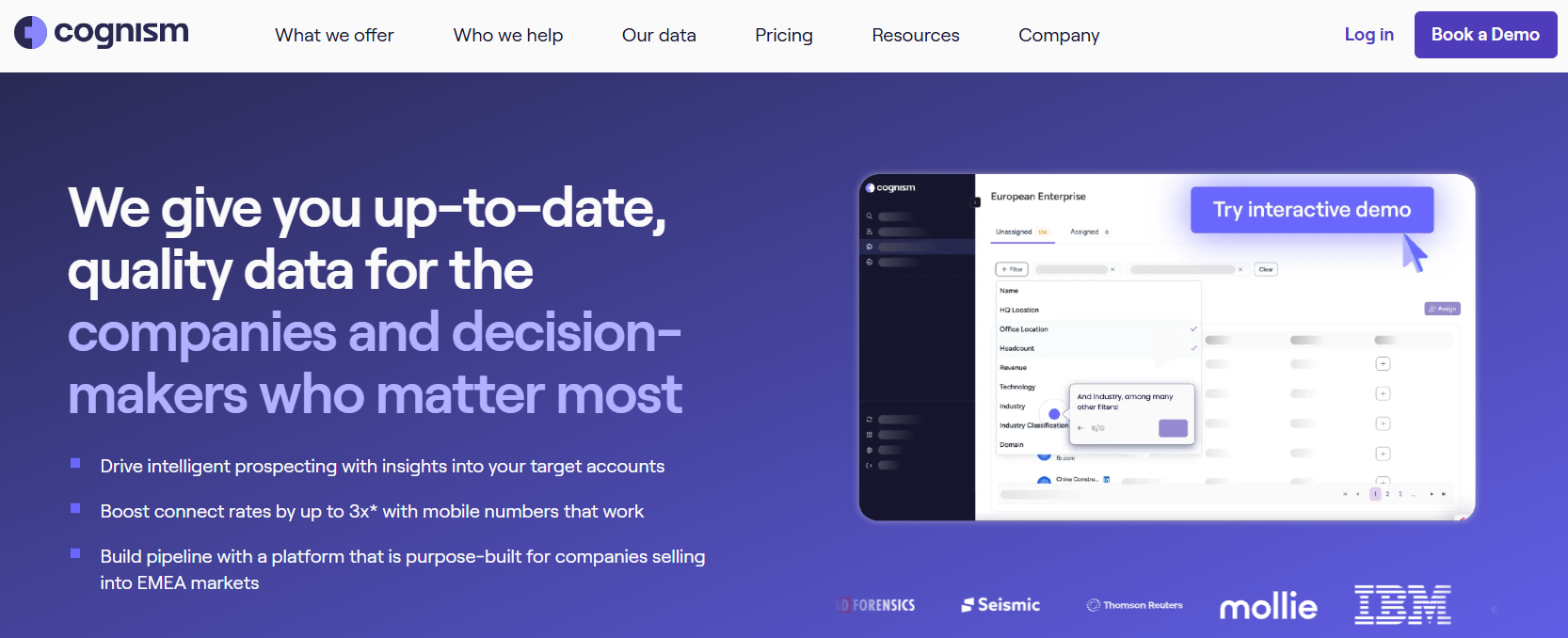
11. Cognism
Cognism is a premium B2B data provider that directly competes with Lusha for contact accuracy. It is widely considered the best platform for European data, offering strictly verified mobile phone numbers that comply with regional privacy laws.
Source:Cognism
Pros:
- Vastly superior verified mobile number data for European and UK markets compared to US-centric tools.
- "Diamond Data" verification ensures that reps are calling accurate, active phone lines.
Cons:
- It is a static database that requires human SDRs to manually search, export, and sequence leads.
- Pricing is highly prohibitive for small teams, locking users into expensive, long-term enterprise agreements.
- Custom enterprise pricing only, typically starting around $15,000 per year.
Best For: Mid-market to enterprise sales teams targeting the EU/UK who require highly accurate direct dials for cold calling.
Pricing Showdown: The True Cost of Identification
When evaluating how to identify company visitors on website assets, you must look past the entry price. Legacy databases hide their true costs behind annual lock-ins, user seat minimums, and restrictive credit systems.
The "Hidden" Cost of Lusha
Lusha is famous for its accessible pricing, starting at around $39/user/month. However, that low price hides a very restrictive "Credit System":
- The Credit Ceiling: The basic plan only gives you a small handful of credits per month. If you are tracking website visitors or building lists, you will burn through your allowance in days.
- Pay-to-See: You are charged a credit just to look at an email address or phone number.
- The "Do It Yourself" Tax: Once you buy the data from Lusha, your work has just begun. You still have to pay for an email sequencing tool, write the copy, and manage the campaign yourself.
The Vison AI Advantage:
- Kwin by Vison AI offers a much higher ROI for growing teams.
- Generous Freemium: You get 100 identified leads/month for FREE forever (compared to Lusha's 5 free credits).
- All-Inclusive Starting Price: At $56/month, you don't just get the data. Kwin autonomously researches the lead, writes a hyper-personalized email, and sends it out. You pay for the lead, but the AI labor is free.
Here is the realistic pricing breakdown for all 11 tools in 2026.
Why AI Employees Are the Future of Lead Generation
The era of paying for static databases and browser extensions is ending. You can buy a massive contact list and force your SDRs to manually hunt for emails, or you can embrace the future of AI-driven revenue generation.
Because AI Discovery has reduced overall web traffic, capturing the high-intent buyers who actually land on your site is mandatory. Kwin solves the fundamental flaw of legacy passive data providers. You do not need more passive data; you need more booked meetings.
Conclusion
If you are tired of burning expensive credits just to reveal a single phone number, it is time to upgrade your tech stack. In 2026, the best Lusha alternatives are active AI employees that close the gap between anonymous traffic and closed-won revenue.
Stop letting 98% of your high-intent traffic vanish into the dark funnel. Hire your first AI Business Developer today to identify website visitors without forms automatically.